Article takeaways
- Declutter before you pack: Selling or donating unused items before a move reduces storage costs, speeds up settling in, and can put extra cash in your pocket to offset relocation expenses.
- Match your storage type to your situation: Short-term, portable, or on-base storage suits TDY and temporary assignments, while off-base commercial units with climate control and flexible leases are better for long deployments and PCS moves.
- Prioritize flexibility in storage contracts: Month-to-month leases and no-penalty termination clauses are essential for military timelines, which can shift unexpectedly at any time.
- Pack with a system: Labeling boxes by room and contents, color-coding bins, and maintaining a digital inventory saves significant time during unpacking and protects you if an insurance claim becomes necessary.
- Protect documents and valuables intentionally: Legal documents should be stored in fireproof safes or with a trusted attorney, while digital backups on a USB or cloud service work well for everyday-use cards and records that don’t require physical originals.
Frequent moves and deployments are a standard experience for military families. However, no matter how frequent they are, most families of active military members dread the inconvenience of relocating.
For deployments, tours of duty, or a temporary duty assignment (TDY), you often need to find long-term storage solutions to keep your items safe while deployed. For permanent changes of stations (PCSs), you have to pack all of your belongings to move across far distances to new military bases. In some cases, that involves heavily downsizing your living situation and living out of boxes in the meantime.
In addition to all these challenges, the Army Sustainment Command stopped funding military storage requests for deployed military personnel in October 2023. As a result, military members and their families have to pay out of pocket for self storage solutions, which can quickly cost a pretty penny.
However, the more informed you are before a transition like a PCS, a TDY, or a deployment, the easier the change will be. In this guide, we’ll walk you through ways to save you and your family time, stress, and costs when relocating.
We’ll cover how to declutter and pack before the move, and the various military storage unit options available to you and your family.
We’ll also reveal how SelfStorage.com can help you find the ideal unit size you need with all the features that will keep your belongings safe during your military service.
Decluttering Before a Military Move
Before opening a box, save time for yourself by decluttering first. Instead of packing and storing all those outdated personal items you don’t need or use anymore, you can simply donate or sell them. This means fewer boxes and less space to store these items, which can help reallocate costs later when shopping for storage and relocation expenses.
Decluttering also helps you settle into a new home faster. Instead of unpacking items you rarely use like impulse purchases, you can focus on setting up the essentials. Plus, donating or selling unwanted items before a move can provide extra cash or help another military family in need.
Active service members from all military branches who move frequently should be more strict during the decluttering process. This way, you will have fewer items to move, making frequent moves easier.
What To Sell vs. What To Donate
When decluttering, you’ll need to categorize all of the items in your house into categories of what to store, what to sell, and what to donate.
Donating clothing is an excellent option for active duty service members who live in their uniforms most of the time. Drop clothing, home goods, and everyday essentials that are still in good condition but no longer needed off at a donation center, and they’ll take care of the rest.
If you keep a receipt, you can also use the donated items as a tax deduction. Military-friendly donation programs like Goodwill, Salvation Army, and base thrift shops often help streamline the donation process and ensure other active duty service member military families receive the items they need at affordable prices.
Selling, however, can help you offset relocation costs while decluttering. If you have furniture, electronics, and outdoor gear you’re not interested in using in the future, you can list them on platforms like Facebook Marketplace, OfferUp, and local military exchange groups.
You’ll need to store anything you don’t sell or donate. You can use our platform to find vehicle storage for any cars or trucks you’re leaving behind.
Choosing the Right Storage Solution

When finding the right storage solution, you have several options. The type you choose depends on your budget, how long you need to store items, and whether you’ll need access to them during the transition.
Short-Term vs. Long-Term Storage Options
You can categorize your storage options into short-term storage and long-term storage. Your choice between the two will depend on your relocation. If you’re on a temporary deployment or TDY, look into short-term storage, such as:
- Month-to-Month storage units: Many companies offer month-to-month rentals to accommodate unpredictable military timelines.
- Portable storage: If you prefer to pack at your own pace, portable storage, such as those offered by PODS, U-Pack, or U-Haul U-Box, can be kept at your home or a secure facility until you’re ready to move.
- On-Base storage facilities: Some military bases offer low-cost or temporary storage options for short-term storage needs.
If you are going on an extended deployment, opt for long-term storage, as you’ll need to store the personal items you can’t bring in a safe environment. For Permanent Change of Station (PCS) moves, use portable storage to help haul items you’ll need at your future home.
Either option may also be ideal if you’re facing a delay when moving to a new duty location. For example, if you’re staying at a hotel, many storage units can hold your large items until you find a larger space.
On-Base vs. Off-Base Storage Options
Military personnel can choose between on-base storage facilities and off-base self-storage facilities. Your choice will depend on your preferences for cost, convenience, security, and accessibility.
For example, on-base storage facilities are cheaper and located near barracks or housing areas, making them more accessible. They also feature restricted public access and higher security measures, making them more secure. However, selection is often more competitive due to limited storage availability.
On the other hand, commercial storage facilities are more available and feature more amenities such as climate-controlled storage and 24/7 storage unit access.
Many companies also offer military discounts and month-to-month rentals to lessen costs. While most off-base storage units provide security through electronic gate access and individual door alarms, you can ensure extra security by looking for facilities that provide:
- 24-hour video recording
- Onsite management
- Electronic gated entry
- Security cameras
In addition, your choice between on-base and off-base storage options may depend on your circumstances. On-base storage can be more convenient for a short-term move or temporary base assignment. On the other hand, use an off-base storage unit if you are going through a PCS move or overseas deployment storage.
Flexible Storage for Uncertain Timelines
More than anything, it’s essential to find flexible storage. When you’re waiting for military housing or dealing with a last-minute Permanent Change of Station, having a storage solution that adapts to your schedule can reduce stress and save money.
One way storage facilities achieve this is through month-to-month rental agreements. With this type of contract, you can avoid unnecessarily long year-long contracts that can be more expensive.
Month-to-month rentals also allow active military members to move their stored items if a relocation date changes. You can also prorate the contract, so you’re only paying for the exact days you use the facility if you ever need to move.
In addition, many facilities will offer flexible contracts that allow you to terminate contracts without fees or don’t include minimum rental periods. These facilities will often work the best for military families — no matter how chaotic the schedule is.
Packing and Organizing for Easy Transitions
If you’re facing yet another move, throwing everything in boxes without a second glance may be tempting. However, packing for the move with intention and taking inventory as you go can help save you time and frustration later. One way you can do this is by labeling your boxes.
Not only should you detail what’s in the box, but you should also detail where the box belongs. For example, if you’re packing dishes, you would write, “Kitchen – Dishes.” This helps you easily place your boxes throughout the house with little confusion.
You can also color-code your bins so that each color is assigned to a specific room or category of items. For example, use blue bins for kitchen items, green for bedroom essentials, and red for fragile items.
Or you can use digital inventories to scan barcodes, upload photos of your items, and detail what’s in the box. This helps you figure out where everything is and can also be helpful if you need to make a storage insurance claim later for lost items.
You should also consider what to pack first before opening any boxes. Typically, you want to pack items you won’t need immediately, such as seasonal decorations and furniture. Start with items you don’t need regularly.
Pack the items you use regularly last, such as additional clothes and cookware, and label them “open first.” Keep essential items like clothes and bedding in an easy-to-access bin or bag.
Protecting Valuables and Sentimental Items
When packing, you’ll inevitably encounter valuables and sentimental items, such as military awards and family heirlooms. It’s essential to pack and store these items carefully.
- Military awards and medals: Store awards and medals in protective display cases or padded boxes to prevent scratches and tarnishing. For long-term storage, wrap medals in acid-free tissue paper and store them in airtight containers to protect against moisture and dust.
- Heirlooms and fragile items: Wrap fragile heirlooms like glassware, ceramics, and photo frames in bubble wrap or foam padding. Store these items in sturdy, clearly labeled boxes, and avoid stacking heavy items on top of them.
If you need to store any of these items long-term, utilize climate-controlled storage, which protects items from extreme temperatures and humidity. Climate control is ideal for military uniforms, photographs, electronics, musical instruments, and wooden furniture.
Active service members can also consider insuring your valuables through your storage unit, home insurance or renter’s insurance provider, or the Full Replacement Value (FRV) Protection Program, which provides limited coverage for military families using government-contracted movers.
What To Do With Seasonal and Bulky Equipment
Seasonal and bulky equipment are some of the most frustrating items to store when moving. Many seasonal items, like winter clothing, holiday decorations, and sports gear, can take up a lot of space — space you may or may not have in a storage facility. However, if you use these tips, it’ll be easy to trim down your allotted space and can make it easy to access your items when you need them:
- Winter clothing: Use vacuum-sealed storage bags to compress bulky coats, sweaters, and blankets, saving space and protecting them from moisture and pests. Label each bag or bin with its contents, and store items in a cool, dry place.
- Holiday decorations: Pack fragile decorations in sturdy plastic bins with dividers to prevent breakage. Label each bin by holiday (e.g., “Christmas – Lights” or “Halloween – Outdoor Decor”) for easy identification. Store artificial trees in dedicated storage bags to protect them from dust and damage.
- Sports equipment: Clean and dry all sports gear before storing it to prevent odors and mildew. Use wall-mounted racks or shelves to keep items like bikes, skis, hunting, and camping gear organized and off the floor. Consider renting a drive-up storage unit for bulkier equipment like kayaks or paddleboards. Drive-up access provides more effortless loading and unloading.
If you have formal uniforms, store them in breathable garment bags that you can hang, preventing dust, moisture, and wrinkles. You can also store uniforms in labeled bins every day. Any tactical gear you have should be in plastic bins with tight-fitting lids. You should also clean all these items to prevent odors and mold from building up during storage.
Any outdoor equipment, like patio furniture, can also occupy a lot of space. While you may be tempted to keep it outside while you’re gone, too much exposure to the elements can lead to weather damage. Instead, find a storage facility where you can keep it safe.
Auto storage is also worth considering for motorcycles, cars, and RVs when it doesn’t make sense to haul them to a new duty location. Many facilities offer vehicle parking options with covered parking to protect against sun and weather damage.
You’ll also have added security features for protection. This way, you won’t have to worry about expensive items when you’re gone.
Storage Tips for Families During Deployments
Just like with packing, storing your items before deployment requires strategy. With these tips, however, you can make the transition easier:
Prepare a Storage Plan Before Deployment
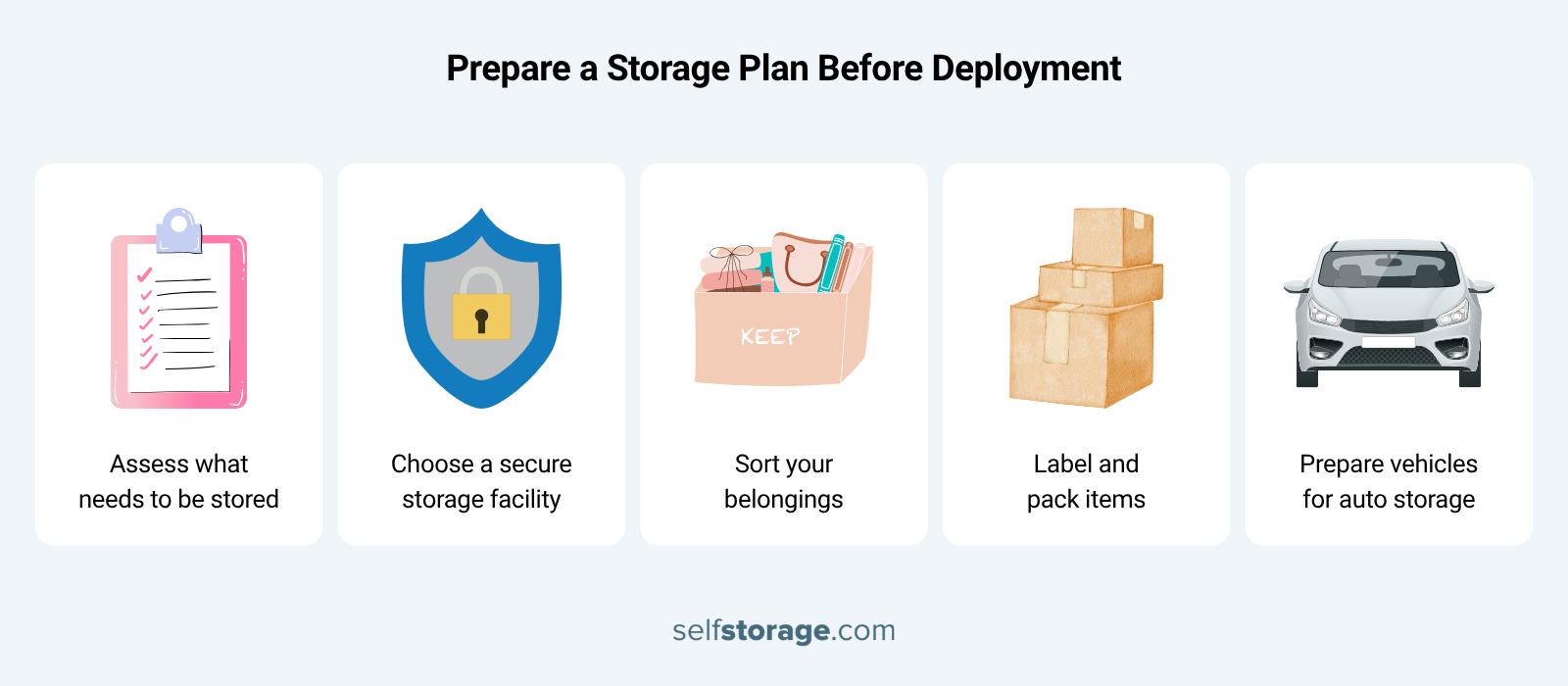
The last thing you want to do is commit to a storage unit that’s too small, unnecessarily large, or doesn’t suit your needs. Instead, creating a plan when packing and storing your items is better. When going through the process, use this checklist:
- Assess what needs to be stored: Identify items that need long-term military storage units, including furniture, seasonal gear, vehicles, and valuables. On the other hand, take items you and your family will need during deployment, sentimental items, and high-value items.
- Choose a secure storage facility: For added flexibility, choose a facility that offers climate-controlled units, 24-hour video recording, military discounts, and month-to-month rentals.
- Sort your belongings: Create a detailed list of all items in storage, including photos, descriptions, and estimated values.
- Label and pack items for long-term storage: Use durable, weather-resistant containers and label each box clearly. For valuable or fragile items, use bubble wrap and protective padding. Avoid using cardboard boxes for long-term storage, as they can degrade over time.
- Prepare vehicles for auto storage: Clean and service vehicles before storage. Fill the gas tank, add a fuel stabilizer, and disconnect the battery.
Lastly, identify a trusted individual who can access your storage unit during emergencies. When identifying them, ask for permission beforehand and provide essential information about the unit, such as the facility’s address, unit number, gate codes, and where to find the keys.
Keep Documents and Records Safe
Active duty service members will also want to ensure legal documents, records, and military information are safely stored, organized, and easily accessible. The best way to ensure that is through the following methods:
- Use fireproof and waterproof safes: Store original documents such as birth certificates, marriage licenses, passports, Social Security cards, and military orders in a fireproof and waterproof safe. This protects against natural disasters and household accidents.
- Organize documents in labeled folders: Use labeled folders or binders to separate categories like medical records, financial documents, legal paperwork, and military service records.
- Keep documents accessible: Store frequently needed documents, such as military identification and deployment orders, in an easily accessible location while storing less-used items securely.
- Use archival-quality storage materials: Use acid-free folders and sleeves to prevent paper degradation for long-term storage. Avoid storing documents in areas with high humidity or temperature fluctuations.
It’s also best to use a mixed approach when deciding what to store digitally and physically. For example, you can digitally store military IDs, health insurance cards, etc., on a USB or cloud service. This way, you can easily access them wherever you are—even if the physical copy is thousands of miles away.
However, some documents need to be stored physically to be effective. For example, passports, wills, legal documents, power of attorney forms, birth certificates, and property deeds are only deemed legally enforceable as physical documents.
Digital copies are too easy to forge, so many courts, systems, and other institutions won’t recognize a digitally stored copy. You can store these documents in a fireproof safe or with a trusted family member or attorney to keep them safe.
SelfStorage.com Can Help Find Military Storage Units for Families

Even if frequent relocations and tours of duty are a part of military life, they don’t have to be a pain. With the right storage solutions, packing strategies, and decluttering, the military community can make these transitions a breeze — and focus less on the journey to enjoy the next adventure.
But leaving home for any reason, including military deployment, is already emotional enough without forcing yourself to get rid of sentimental possessions.
Parting with the personal belongings that have made you comfortable can feel overwhelming, even when it’s temporary. This is especially true when you’re already facing the uncertainty of being stationed in a new country.
That said, downsizing the load you’re shipping out with doesn’t have to mean going full minimalist. That’s where self-storage comes in.
Whether you’re storing family heirlooms until you’re settled, keeping your belongings safe during a temporary assignment, or simply creating a safety net while you test out your new life abroad, using self-storage as a solution can elevate your financial and mental health.
That might mean booking one storage unit close to home, where you can store things you won’t need while on active duty. And booking another unit near the military bases you’re stationed at for you and your family to have access to what they need.
But how do you find a unit with the amenities you need? And how big of a unit are we talking about here?
SelfStorage.com is here to help.
First, check out our storage unit size guide to find out the various dimensions and layouts available, and what can fit in each.
Then, use our signature self-storage search tool makes it easy to compare storage facilities in your area. Just punch in your zip code and use our amenity filters to isolate your ideal storage units by price, amenities like climate control and enhanced security features, and location.
And we’re not the only ones who have your back. Here are some other resources you and your family can use.
Resources for Military Families Over Break
Military Moving Assistance Programs
- Military OneSource: A key resource for active-duty service members and their families, Military OneSource offers personalized relocation counseling, moving checklists, and connections to essential programs.
- The Defense Personal Property Program (DP3): Managed by the Department of Defense, DP3 helps coordinate household goods shipments for military families during Permanent Change of Station (PCS) moves.
- Armed Services YMCA: Provides financial and logistical support to military families facing relocation challenges.
Affordable and Flexible Storage Options
- SelfStorage: SelfStorage is a storage comparison shopping site that provides you with storage recommendations based on your location, your desired size of storage unit, and what you want to store.
- SpareFoot: SpareFoot is a storage unit marketplace that helps consumers, including military members, find reliable storage options.
- U-Haul Military Move Program: Offers discounted prices and more service options for storage solutions.
- CubeSmart Military Storage: Offers a 5% discount and flexible leasing options for military families shopping for storage units.
Financial Assistance and Budgeting for Moves
- American Armed Forces Mutual Aid Association (AAFMAA) – 8 Things to Consider When Budgeting for a PCS Move: This article provides tips for budgeting before making a PCS move.
- Army Emergency Relief (AER), Air Force Aid Society (AFAS), and Navy-Marine Corps Relief Society (NMCRS): These organizations offer grants and zero-interest loans for moving-related expenses.
- Dislocation Allowance (DLA): The military reimburses certain relocation costs, including per diem allowances, temporary lodging expenses, and the shipment of household goods.