
Article takeaways
- Studios generally offer lower monthly costs, while one bedrooms provide more privacy, storage, and room for daily routines.
- Most renters give up 200–300 square feet when choosing a studio, which affects comfort, hosting, and layout flexibility.
- Pairing a studio with a small storage unit often costs significantly less than upgrading to a one-bedroom while still creating a comfortable living space.
- The best layout depends on how you live, your work habits, hobbies, privacy needs, and long-term plans.
- Comparing full monthly costs and touring apartments in person is the most reliable way to decide which setup fits your lifestyle and budget.
Choosing between a studio and a one-bedroom apartment shapes daily living more than most renters expect. Studios keep costs low and centralize life into one open room. One bedrooms create privacy, structure, and space for hobbies, guests, and remote work. The right choice depends on how you live, how much room you need, and what you are willing to trade off. With rising rent in most cities, many renters now combine a studio with a small storage unit to stay in desirable neighborhoods without stretching their budget.
What is a Studio Apartment vs a One Bedroom?
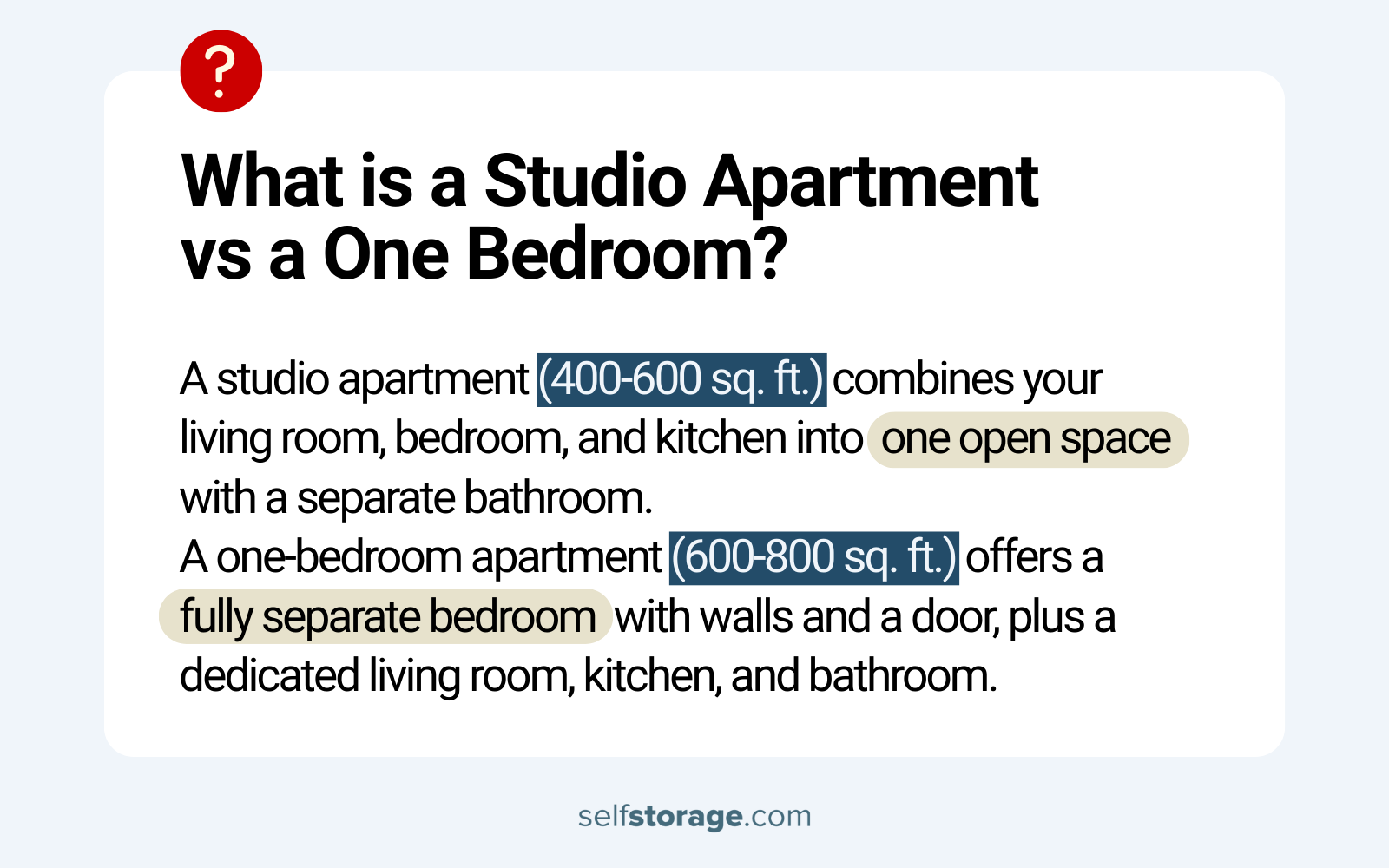
A studio apartment combines your living room, bedroom, and kitchen into one open space with a separate bathroom. Most studios range from 400 to 600 square feet, though micro‑studios in dense cities can be smaller. Storage tends to be limited, often to a single closet, which encourages renters to keep belongings streamlined or use external storage to stay organized.
A one-bedroom apartment offers a fully separate bedroom with walls and a door, plus a dedicated living room, kitchen, and bathroom. Most one bedrooms fall between 600 and 800 square feet. This layout typically includes multiple closets or built‑ins, making it easier to store linens, luggage, seasonal clothing, and hobby equipment without crowding the main living areas.
Key Structural Differences
- A studio places your entire routine in one shared room, while a one-bedroom spreads life across distinct zones.
- One bedrooms provide more storage, clearer separation between rest and activity, and greater layout flexibility.
- Privacy levels differ significantly. Studios keep everything visible, while one bedrooms allow you to create boundaries.
- Larger square footage in a one-bedroom supports hosting, remote work, and hobbies more comfortably.
Studio vs One Bedroom Apartment: What Daily Life Actually Feels Like
A studio places nearly everything in one shared space. Renters who are downsizing from a larger home often notice this most clearly, and resources on downsizing your home can help ease that transition. The living area, bed, and kitchen flow together, and a single closet often handles all storage.
A one-bedroom shifts the experience entirely. For renters transitioning from compact or micro-living setups, drawing on real experiences from living in a micro-apartment can clarify how much separation and additional square footage might actually improve daily comfort. With 600 to 800 square feet on average and a separate bedroom, daily routines naturally spread out. You can shut the door for quiet, get dressed without walking through the living room, and host friends without rearranging the entire apartment. The added closets and wall separation often create a sense of calm that many renters value, especially remote workers or couples.
The core differences come down to:
- Privacy
- Storage capacity
- Layout flexibility
- Ability to create defined zones for work, rest, and hosting
A studio centers every part of your day in one room. A one-bedroom creates a home with more distinct spaces.
How Costs Compare in Real Life
Rent is the biggest dividing line between studios and one bedrooms. In many markets, one bedrooms rent for more than studios, often by a few hundred dollars per month, but the exact gap depends heavily on the city, neighborhood, and building.
National Trends
National rent reports show that median studio and one-bedroom prices often fall within a similar overall range, but within individual cities, one bedrooms typically cost more due to added square footage and layout flexibility. Utilities also rise with space, and furnishing a larger home can increase upfront costs, along with the hidden costs of moving that often show up during the transition.
How the Numbers Shift in Large Cities
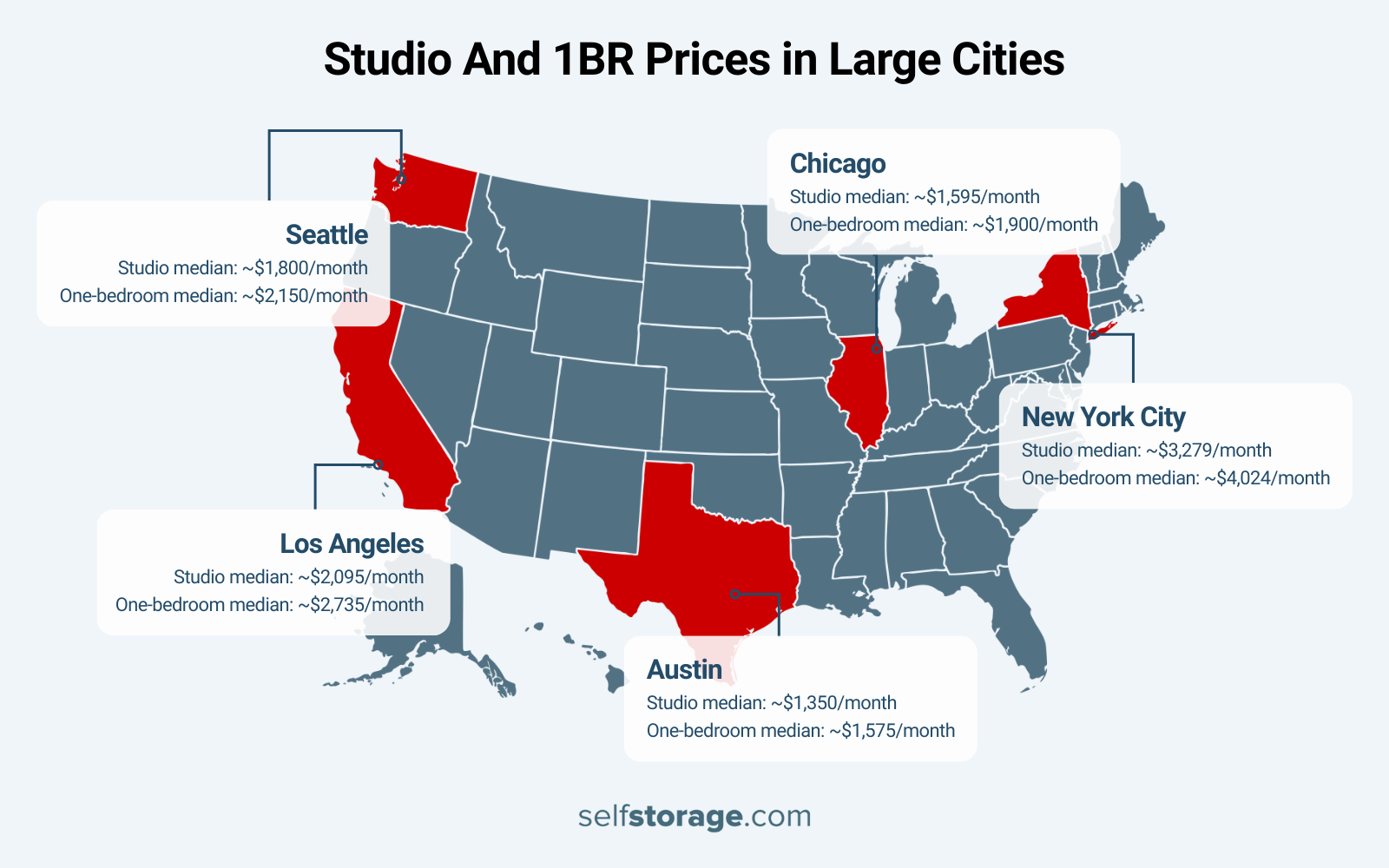
If you’re comparing cities, here’s a quick look at what renters are actually paying for studios and one bedrooms right now. Rent pricing can shift a lot between neighborhoods, building styles, and amenities, so think of these numbers as a helpful starting point.
| City | Studio Median | One-Bedroom Median |
|---|---|---|
| New York City (NYC) | ~$3,279/month | ~$4,024/month |
| Los Angeles, CA | ~$2,095/month | ~$2,735/month |
| Chicago, IL | ~$1,595/month | ~$1,900/month |
| Seattle, WA | ~$1,800/month | ~$2,150/month |
| Austin, TX | ~$1,350/month | ~$1,575/month |
These numbers highlight how quickly rents escalate when moving from a studio to a one-bedroom, especially in higher‑cost coastal markets. The jump can be modest in some cities and dramatic in others, which is why evaluating both rent and storage options together often gives renters a clearer financial picture.
Utilities and Furnishing Costs
Smaller spaces require less furniture and generally cost less to heat, cool, and furnish. Moving into a one-bedroom can bring higher upfront expenses simply because there’s more space to fill and organize.
The Storage Factor
Choosing a studio and adding a small storage unit can cost far less than upgrading to a one-bedroom. For renters comparing long‑term expenses, understanding how storage reduces the cost of living helps clarify the financial benefits.
Seasonal clothing, luggage, holiday decor, library collections, and sports gear often outgrow small apartments, making small‑apartment storage hacks especially helpful.
Pro Tip: If you’re comparing both layouts, look at the total monthly cost of each option. Add the price of a studio and a small storage unit (if needed) and compare it to the full monthly cost of a one-bedroom.
National Average Housing Cost Comparison
Below is a national-average look at what renters typically spend on housing across the country. Seeing these numbers side by side makes it easier to understand how each layout fits into a real monthly budget and where the biggest cost differences usually appear.
National Median Monthly Costs:
- Studio rent: ~$1,500/month
- One bedroom rent: ~$1,650/month
- Average utilities: $120–$150 (studio), $150–$180 (1BR)
- Renters insurance: $15–$22/month
- 5×5 storage unit: ~$75/month
- Furnished premiums: +$150–$300 (studio), +$200–$400 (1BR)
| Cost Type | Studio | One Bedroom |
|---|---|---|
| Fully Furnished Option (Monthly Add-On)* | +$150–$300 | +$200–$400 |
| Rent (Annual) | $18,000 | $19,800 |
| Utilities (Annual) | $1,500 | $1,900 |
| Insurance (Annual) | $180 | $220 |
| Optional Storage Add-On | +$900 annually | Only if needed |
| Total Annual Cost | $19,680 (or $20,580 with storage) |
$21,920 (or more if storage is needed) |
**Sources: ApartmentAdvisor National Rent Report (2025), Apartments.com U.S. Market Trends (2025), U.S. Energy Information Administration Residential Energy Data 1, 2, + 3, Policygenius & NerdWallet Renter’s Insurance Reports
In this example, a studio paired with storage ends up several thousand dollars less per year than a one-bedroom.
Once you start picturing your daily routine, how you work, relax, and move through your space, the differences between a studio and a one-bedroom become much clearer. This is where renters usually get a true sense of what feels comfortable and what feels cramped.
Studio Living
Studios rely heavily on how well you arrange them. Area rugs, bookshelves, and thoughtful furniture placement can create mini‑zones, but everything still happens in one shared room. That means certain items rarely fit without crowding the space:
- Large sectionals
- Full dining sets
- Home gym equipment
- Bulk household supplies
- Instruments or creative project materials
Most studio renters get creative by rotating items seasonally, storing less-used belongings, using small apartment storage hacks, or leaning on a small storage unit to keep their home feeling open instead of overloaded.
One Bedroom Living
A one-bedroom naturally gives your day more structure. The bedroom becomes a quiet retreat, the living room has room to function without constant rearranging, and hobbies or work setups don’t spill into sleep space. Extra closets make it easier to keep linens, luggage, seasonal clothing, or sports gear tucked away without relying on creative solutions.
Storage Reality
Studios typically offer one small closet. One bedrooms often include multiple closets, but renters with hobbies, pets, or bulky gear still benefit from off-site space.
Pro Tip: Renters in walkable or high‑density cities often treat storage as an extension of their apartment, a way to stay organized without paying higher rent for a larger unit.
How Each Layout Fits Your Lifestyle
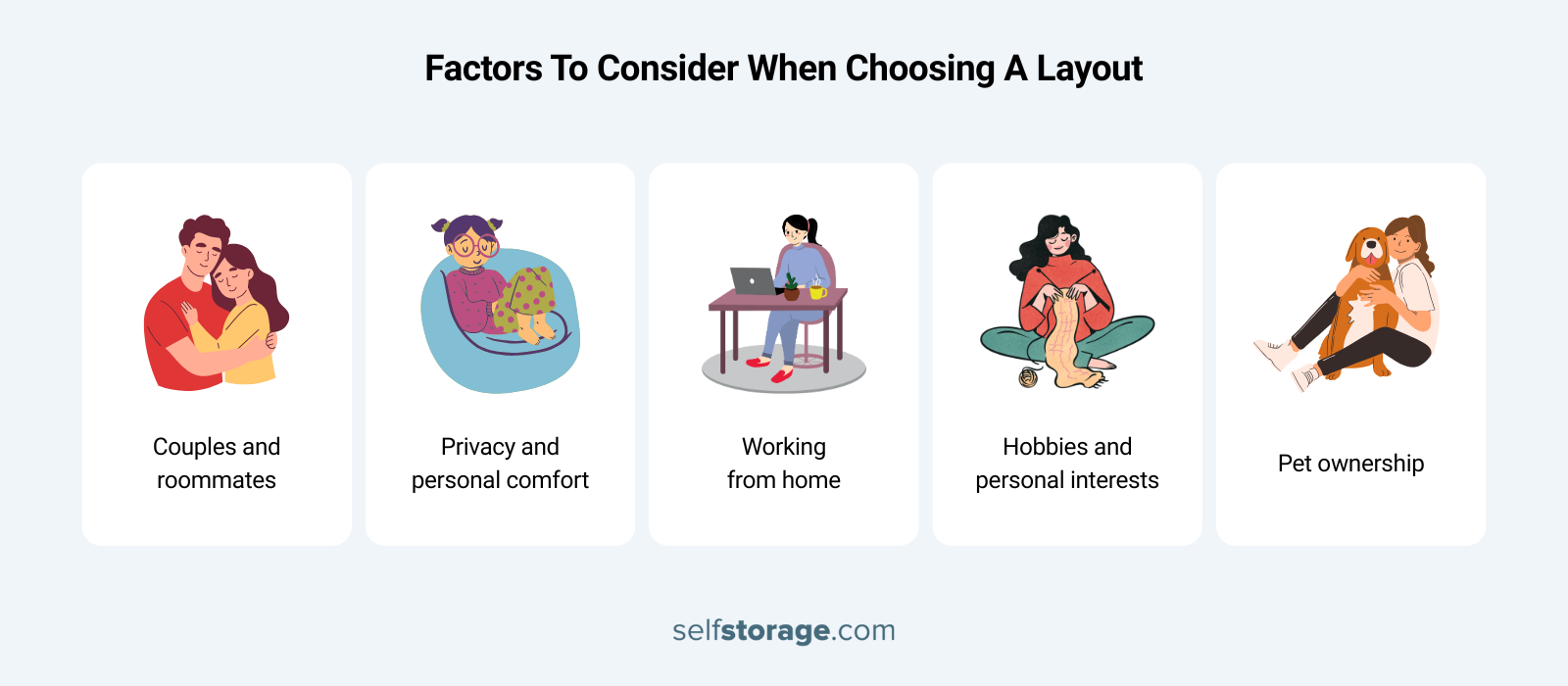
Privacy and Personal Comfort
A studio works well for renters who live alone, travel often, or prefer simple living. Everything stays within reach, and the open layout makes it easy to settle in quickly. A one-bedroom offers a different kind of comfort, a place to shut the door, unwind, and separate rest from the busier parts of your day. Renters who host friends, keep varied schedules, or share a home with a partner often appreciate the breathing room a one-bedroom provides.
Working From Home
For remote workers, the difference between these layouts becomes noticeable really fast. In a studio, your desk lives inside your daily life, next to the bed, across from the kitchen, or beside the sofa. Some renters make this work with storage to keep equipment tucked away between meetings. A one-bedroom gives your workspace a dedicated spot, helping you stay focused during the day and disconnect more easily at night.
Hobbies and Personal Interests
Hobbies add joy to daily life, but they also take up space. Musical instruments, crafting supplies, camping gear, sports equipment, and collections often fit more naturally in a one-bedroom. Studio renters often rotate items seasonally or lean on a small storage unit to keep projects manageable without crowding their home.
Couples and Roommates
Layout matters even more when more than one person is sharing the space. Some couples make a studio work with clear communication and streamlined belongings, but many prefer the flexibility of a one-bedroom, especially if they keep different hours or work from home. Roommates generally need separate rooms to feel comfortable in the long term. Renters comparing buildings may also want to factor in whether they’re renting from a private landlord or a company, since policies on guests, deposits, and lease flexibility can vary.
Pet Ownership
Pets can adapt to either layout, but a one-bedroom naturally offers more room for crates, litter boxes, beds, and play areas. A studio can still work well for smaller or lower-energy pets, especially when renters stay organized and keep bulky pet items in storage. Pets adapt to either layout, but one bedroom spaces naturally support crates, litter boxes, beds, and play areas more comfortably.
A Clear Way to Decide
Choosing between a studio and a one-bedroom is rarely just about square footage. Most renters decide based on how they live day to day. How much privacy they need, how often they host, whether they work from home, and how much “breathing room” helps them feel settled. Thinking through the pros and cons of each layout makes the decision more personal and a lot easier to visualize.
Studio vs One Bedroom at a Glance
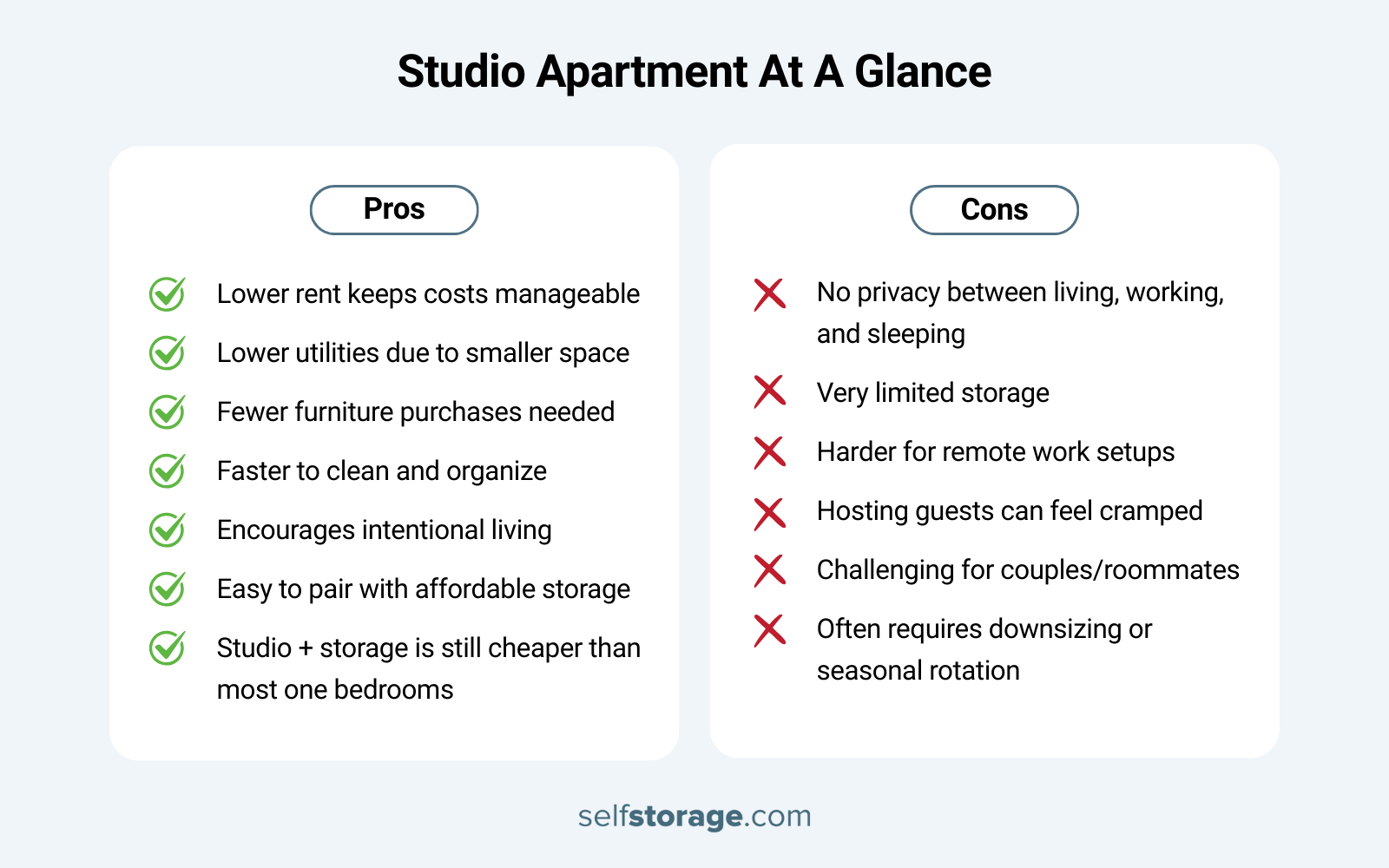
Studio Advantages
Studios appeal to renters who want simplicity, predictable monthly costs, and easy upkeep. They’re especially comfortable for people who are rarely home, love minimalism, or prefer a smaller footprint.
- Lower rent keeps costs manageable
- Lower utilities due to smaller space
- Fewer furniture purchases needed
- Faster to clean and organize
- Encourages intentional living
- Easy to pair with affordable storage for overflow
- Studio + storage is still cheaper than most one bedrooms
Studio Disadvantages
Studios also come with limitations, especially for renters who need separation, quiet, or room to spread out.
- No privacy between living, working, and sleeping
- Very limited storage
- Harder for remote work setups
- Hosting guests can feel cramped
- Challenging for couples or roommates
- Often requires downsizing or seasonal rotation
One Bedroom Advantages
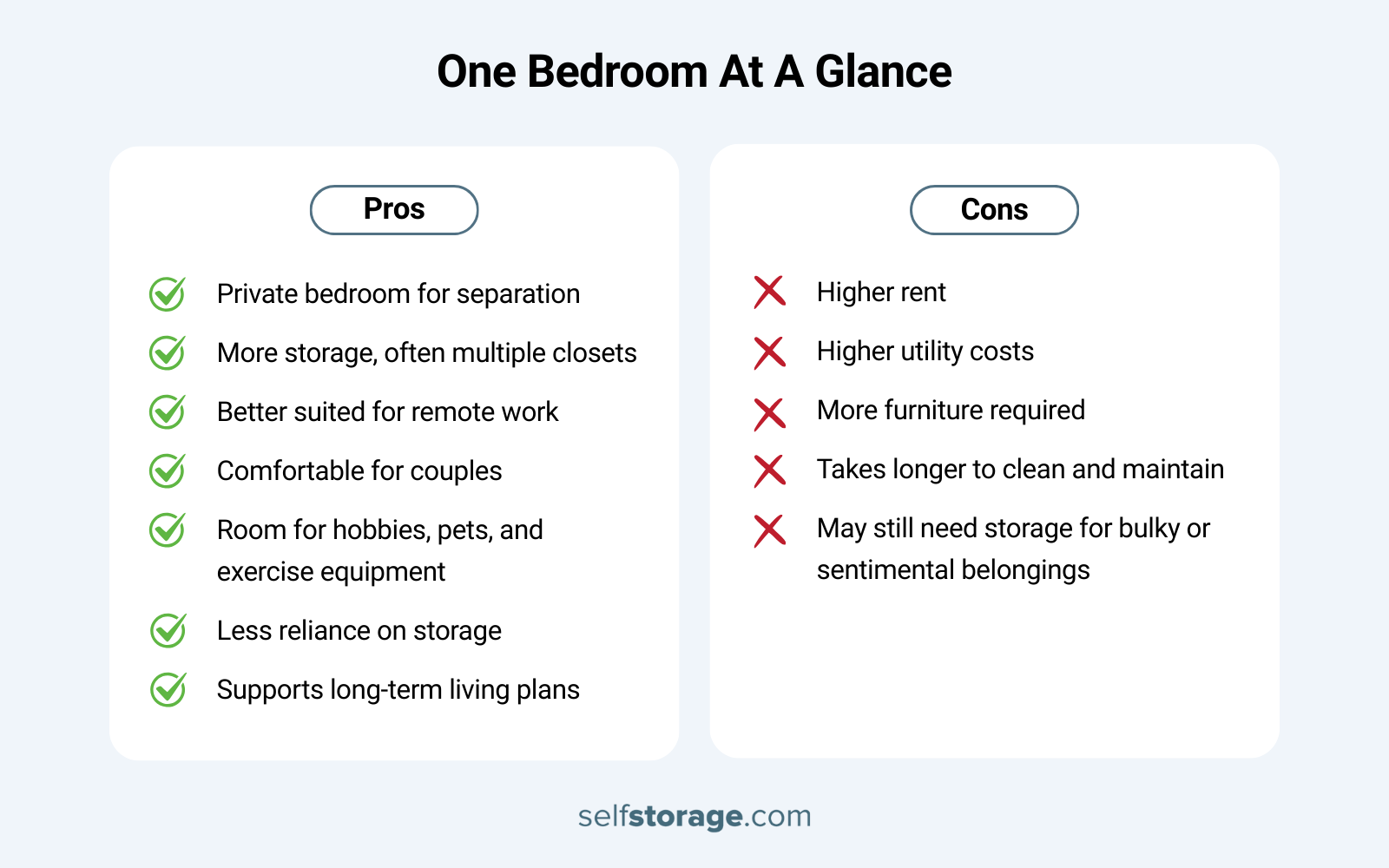
One bedrooms offer comfort, flexibility, and room to grow, literally and figuratively.
- Private bedroom for rest and separation
- More storage, often multiple closets
- Better suited for remote work
- Comfortable for couples
- Room for hobbies, pets, and exercise equipment
- Less reliance on storage for daily essentials
- Supports long‑term living plans
One Bedroom Disadvantages
But extra space comes with extra responsibility.
- Higher rent
- Higher utility costs
- More furniture required
- Takes longer to clean and maintain
- May still need storage for bulky or sentimental belongings
How to Decide Between a Studio and a One-Bedroom
| Choose a Studio If: | Choose a One Bedroom If: |
|---|---|
Budget is your primary concern You live alone and are rarely home You’re comfortable with minimalism You don’t work from home often You rarely host friends You’re saving aggressively toward a financial goal You don’t mind using a small storage unit for overflow You prefer short-term or flexible leases |
You work from home regularly You live with a partner You want a private sleep space You host friends or family often You have hobbies that take up space You prefer everything stored on-site You have pets that need room to move You expect to stay in the area for 2+ years You need a professional home office setup |
A studio fits renters who want low costs, flexible living, and simplicity, while a one-bedroom suits renters who value privacy and routine.
Total Housing Cost Test
Use this quick comparison to ground your decision:
- Add: Studio rent + utilities + storage (if needed)
- Compare to: One bedroom rent + utilities
- Decide whether the savings justify the space trade‑offs
Using the Chicago median example:
- Studio + Storage: $1,670 monthly
- One Bedroom: $1,900 monthly
If the savings align with your lifestyle and the trade‑offs feel manageable, a studio may still be the more practical choice.
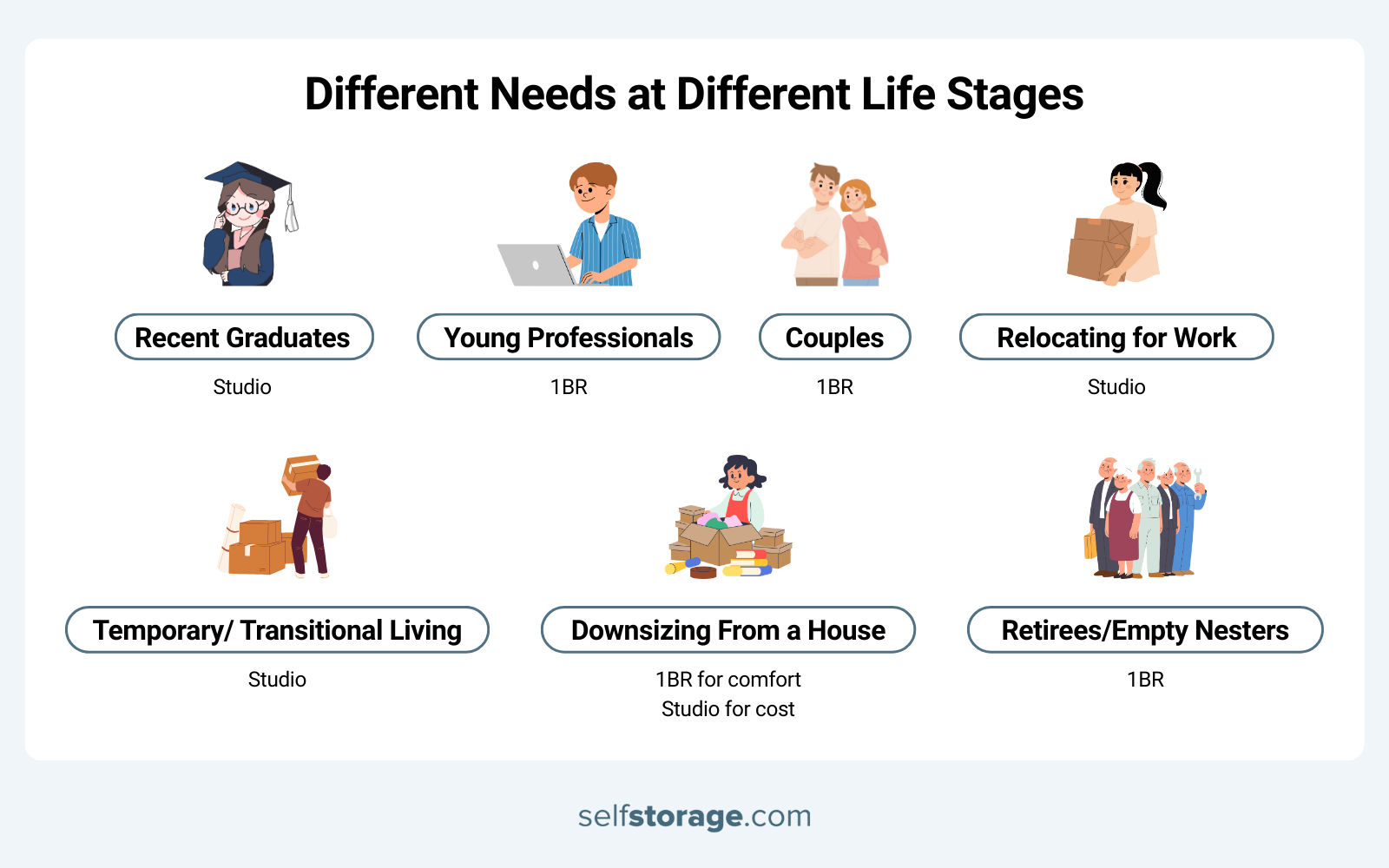
Different Needs at Different Life Stages
Recent Graduates
Studios offer a gentle entry into independent living: predictable costs, easier moves, and space that encourages intentional purchases. Storage helps hold items that don’t yet fit into a smaller apartment.
Young Professionals
Many early‑career renters prefer one bedrooms for better work‑life balance. Remote workers especially appreciate the ability to shut the door on their workspace at the end of the day.
Couples
Most couples feel more comfortable in a one-bedroom, especially if they keep different schedules or have a mix of shared and personal belongings. Storage can help during the transition when combining households.
Relocating for Work
People relocating for work often move multiple times in a short period. Studios paired with storage give breathing room while settling in and keep moves simpler. Storage makes it easier to stagger the transition without cluttering temporary housing.
Temporary or Transitional Living
Renters between leases, renovating, or adjusting to major life changes rely heavily on storage to bridge the gap between spaces, and practical moving day advice can make those transitions much smoother.
Downsizing From a House
Storage plays a huge role here; renters can keep sentimental or seasonal items without overcrowding a smaller apartment. A one-bedroom offers comfort, while a studio + storage keeps costs low.
Retirees and Empty Nesters
Many retirees prefer the comfort and predictability of a one-bedroom. Storage helps hold family keepsakes, heirlooms, and seasonal décor without filling the apartment. A one-bedroom often provides the long‑term comfort they prefer. Storage holds family keepsakes and items they want to preserve.
How Storage Extends What an Apartment Can Do

A storage unit works like the extra closet most apartments don’t have. The one that holds the bulky, seasonal, or sentimental things that make life full but don’t need to live in your day-to-day space. For many renters, it’s the difference between feeling cramped and feeling comfortably settled without paying higher rent for a larger apartment.
Why It Works Financially
Paying for an extra 200–300 square feet in a one-bedroom often costs several hundred dollars more per month. A small storage unit usually costs a fraction of the price difference between a studio and a one-bedroom, especially when you compare it to the cheapest storage unit prices available in your area. It’s a practical middle ground for renters who want flexibility without stretching their monthly expenses.
Real Renter Scenarios
Maybe you just started a new job working from home, and suddenly your apartment has to fit your desk, equipment, AND everyday living. A small 5×5 storage unit can give you a place to keep extra work stuff like old files, equipment, and office furniture. Or you could use your new unit as an extra closet for seasonal clothing, family heirlooms, or seasonal decor, so your workspace doesn’t spill into every corner of your home.
Or maybe weekends are your escape, skiing in winter, camping all summer, biking every chance you get. Gear adds up quickly, and a 5×10 unit can hold everything comfortably, so your apartment still feels like a home, not a gear shed.
Or perhaps you and your partner are moving in together and discovering you own two of everything, two coffee tables, two sets of keepsakes, extra bedding, and the items you’re not ready to part with yet. A storage unit gives you breathing room to settle in without rushing big decisions.
Choosing the Right Unit
Choosing a unit size is a lot like choosing an apartment; it comes down to how you actually live. A little extra space can make everyday life feel smoother, especially when it’s holding the things you love but don’t need underfoot.
Common unit sizes and what they’re best for:
- 5×5: Perfect when your apartment closets just aren’t cutting it. Great for boxes, décor, seasonal clothing, office supplies, or the hobby gear that’s fun to use but hard to store.
- 5×10: A comfortable step up when you’ve got small furniture, instruments, sports equipment, bikes, or bulkier items you don’t reach for daily but still want to keep.
- Climate‑controlled: Ideal when you’re storing things that matter, family photos, artwork, electronics, fabric collections, important documents, anything that shouldn’t sit through extreme heat or humidity.
These options give you room to breathe at home without getting rid of the things that make your space yours.
Using SelfStorage.com
SelfStorage.com makes the whole process feel less overwhelming, more like finding a helpful extension of your home than checking one more task off your to-do list.
- Start by searching your neighborhood so you can see what’s actually close to your apartment (your future extra closet might be just a few minutes away).
- Compare features that matter in real life. Climate control for things you care about, access hours that match your schedule, ground-floor convenience if you’re hauling heavier items, and security that helps you feel at ease.
- Filter by price to stay within budget without giving up the features you want.
- Read reviews from renters who’ve already used the facility so you know what to expect.
- Reserve instantly once you find a spot that fits. No waiting, no guessing, no complicated paperwork.
With the right storage setup, your home feels lighter. Your closets make sense again, your living room stays clear, and you get to enjoy your apartment the way it’s meant to be lived in, whether you choose a studio, a one-bedroom, or something in between.
Finding the Right Fit for Your Space, Budget, and Daily Routine
By the time you compare layouts, costs, and how each space supports your daily routine, the choice between a studio and a one-bedroom becomes much clearer. Studios appeal to renters who want to keep monthly expenses predictable and enjoy a simpler footprint. One bedrooms resonate with people who value separation, privacy, and room for personal routines.
A helpful way to decide is to look at how each option actually supports the life you’re building: the way you work, the way you relax, the amount of room you need to feel settled, and what fits comfortably within your overall budget. Some renters land squarely on one side or the other, while others find that pairing a smaller apartment with a storage unit gives them the balance they’re looking for.