
Article takeaways
- What to Keep & What to Sell: If an item costs more to transport with shipping costs, customs duties, and tariffs than to buy new at your destination, sell or donate it before you move.
- Start your moving abroad checklist 3-4 months early to allow adequate time for selling belongings, gathering documentation, and securing visas. Rushed international moves typically cost 40-60% more than well-planned ones.
- International shipping costs vary dramatically by method: full container loads run $2,300-$3,500 base rate, shared containers cost $120-$280 per cubic meter, and air freight ranges $4-$8 per kilogram—and don’t forget that tariffs, customs fees, and handling charges can add thousands to your final bill.
- Domestic storage at $50-$200 monthly is often more affordable than international shipping for temporary assignments or uncertain moves, since storing belongings for three years typically costs less than half of round-trip international shipping expenses.
- Opening an international bank account early, securing comprehensive health insurance, obtaining your International Driver’s Permit, and keeping digital copies of all important documents in encrypted cloud storage will prevent costly delays and complications during your transition abroad.
Moving abroad has always been a fantasy for the noble few who are open-minded and adventurous enough to wander outside their own borders.
And with global trade, communication, and education climates becoming more interconnected and the political situation in multiple countries growing more complicated, lots of people have made an international move their goal.
Maybe Central or South America has what you’re looking for in terms of cost of living. Or maybe there’s a career you aim to pursue in Asia, or a school in Europe, or ancestral roots in Africa that you feel more attuned to.
Regardless of your reasons, the reality of moving overseas is daunting, and we have more than just the typical packing and storage anxieties. There’s also the financial and logistical complexities you’ll have to prepare for.
Navigating the high international shipping costs, emotional attachment, and future uncertainty can feel like a balancing act. And leaving home already feels like giving up your familiar safety net, regardless of how promising the situation is on the other side of the move.
That’s where using a comprehensive moving abroad checklist might be able to offer you some peace of mind, both as a decision framework and as a preparation tool.
Our moving abroad checklist is more than just a generic packing list. We’ll cover international shipping costs, preparation guidelines, and International moving tips.
We’ll also reveal how our signature SelfStorage search tool can help you save some money on transporting collectibles, antiques, and heirlooms out of the country.
Understanding International Shipping Costs:
One of the first pieces of information to examine when you’re considering moving abroad is the international shipping costs. Of course, these will vary based on method. The primary three international shipping methods used for international moves are full container, shared container, and air freight:
- Full Container Load (FCL): If you’re moving a full, multi-bedroom household, you may need a full container all by yourself. An FCL gives you a 40-foot container for a base rate of $2,300-$3,500, but remember to budget for the full package. A typical move from Los Angeles to Ho Chi Minh City runs about $4,395 total, including all those extra fees like origin charges, destination handling, and documentation. With an FCL, you pay one flat fee whether your container is packed to the brim or half-full, so there’s no penalty for bringing extra belongings.
- FCL Is Ideal For: Families moving entire multi-bedroom households with children.
- Less Than Container Load (LCL): If you’re only moving some of your stuff, or if you don’t own much, you may not need a whole container. With an LCL, you share space with other shippers and pay only for what you use at $120-$280 per cubic meter.
- LCL is Ideal For: Singles moving apartments or single bedroom households and couples with no children.
- Air Freight: If you need your things quickly, air freight is your fastest option. You can get your stuff to China from Los Angeles in just 3 days versus 20-30 days by sea. But air freight runs around $4-$8 per kilogram and will cost you 4-6 times more than ocean shipping.
You can always split your options and consider air freight for important documents, valuables, or that first batch of essentials you’ll need right away while you wait for your main shipment to arrive by sea.
Also, be aware that the new tariff policies on goods coming into the U.S. have resulted in other regions raising tariffs on our outbound shipments as well. You’ll want to do some research on how the triffs work in your destination country and factor that into your budget.
Tariffs can add significantly to your total costs regardless of shipping method.
Your international moving costs will vary quite a bit depending on how much you bring. For example, if you’re moving from North America to Europe, you might pay around $3,500 for a small one-bedroom apartment’s worth of belongings, while a full five-to-six-bedroom home could run you up to $17,000.
If you’re headed to other continents like Asia or Australia, expect these numbers to climb a bit higher thanks to the extra distance.
In many cases, it’s more affordable to put your valuable and sentimental items in storage, especially if there’s a chance you’ll move back later on. If not, you might find it’s cheaper to sell or donate and replace things when you get to your new home than to pay all these shipping costs. We’ll cover the ins and outs of both these approaches down below. First, let’s run through the pre-moving checklist for moving abroad.
Moving Abroad Checklist: What To Do Before You Move
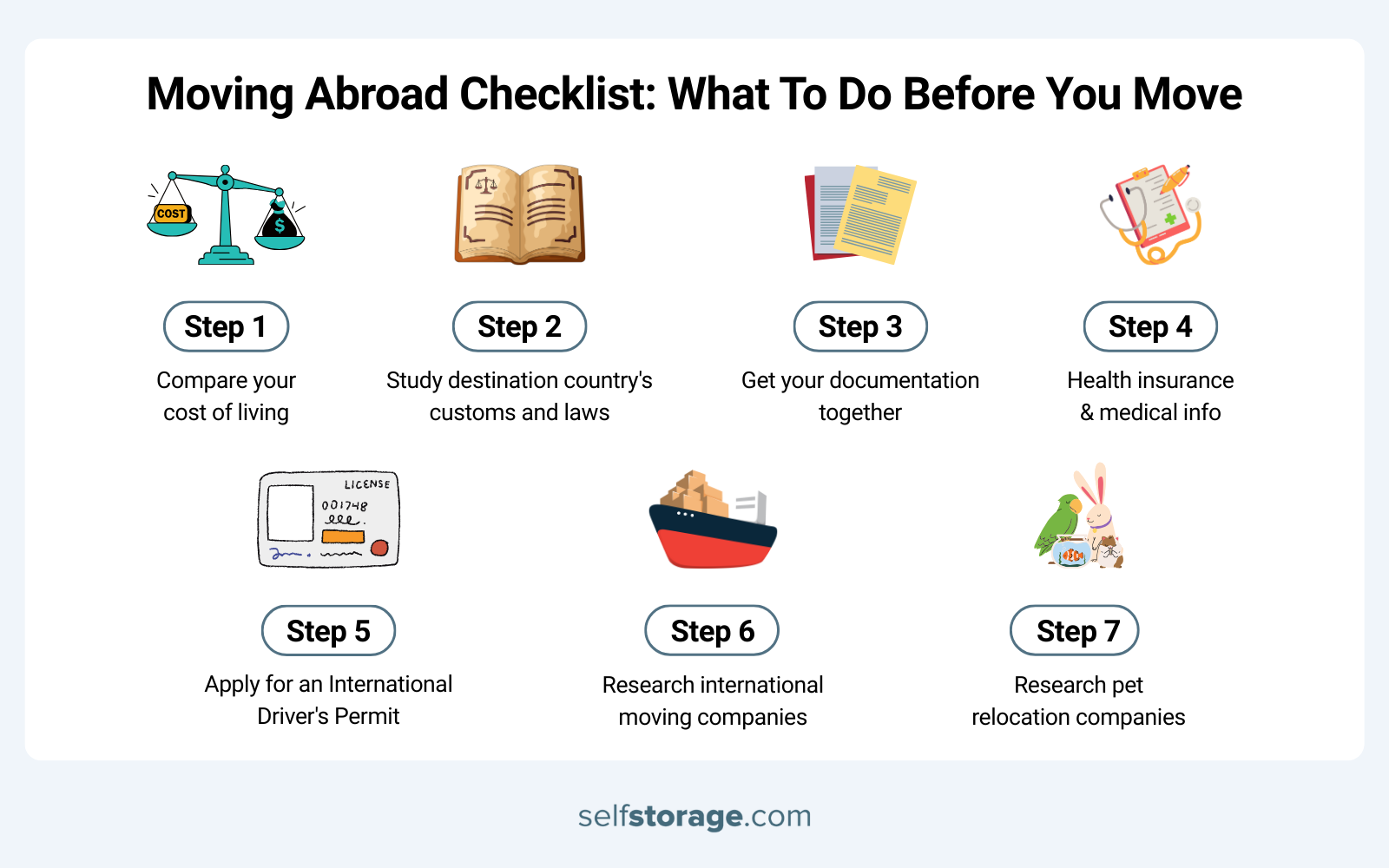
Let’s run through the international moving checklist of items to research and consider as soon as you start planning the move. An international move is like long-distance moving plus the element of feeling like a fish out of water in a whole new culture.
Before you even start thinking about the daunting task of packing and storing your belongings, you’ll want to look into the following checklist items:
1. Compare your Cost of Living
Research the cost of living in your destination homeland, and we don’t just mean your housing costs. You’ll want to look into the everyday expenses like groceries, utilities, transportation, hobbies, and entertainment.
For example, the cost of living can vary dramatically between countries, especially when you factor in visa application fees and work visa terms, security deposit, and potential property management company fees. It’s also prudent to have a contingency fund for unexpected expenses that pop up during any significant life change.
Be sure to factor in existing student loan debt and find out if you can transfer your pension scheme. And if you plan to keep any of your property in your current country of residence, consider how your move will impact your non-resident landlord scheme status and capital gains tax.
We suggest opening an international bank account in your destination country as soon as possible.
Research different banking options and their international services, including currency exchange rates and international money transfer options. Be mindful of exchange rate fluctuations, as they can significantly impact the value of your transferred funds over time. Contact your current bank to learn about its international policies for your existing bank account and whether it’s worth keeping.
2. Study Your Destination Country’s Customs and Laws
Make an effort to get to know the local culture, local language, and social customs of the place you plan to move to. We suggest familiarizing yourself with the laws, especially those affecting expat groups. Work visas and work permits are a great place to start.
Don’t forget about income or property taxes, vaccines and documentation for pets, and the country’s insurance requirements.
3. Get Your Documentation Together
The money stuff isn’t where the boring, administrative side of moving abroad ends, unfortunately. Next up on our moving abroad checklist is gathering all your documentation, which will save you lots of time and prevent delays.
Start with your passport, which needs to be valid for at least six months after your intended stay, and have enough blank pages to accommodate travel. Get your Social Security card and any other national identification documents together and keep them ready.
Certified copies of documents like birth certificates, marriage certificates, and divorce decrees may ease the process of securing visa applications, housing rentals, and employment. You might need academic transcripts, diplomas, and professional certifications for employment or school applications.
Secure all your medical records, including a detailed health history, any chronic conditions, allergies, prescriptions, and past treatments. Your immunization records are often required to enter a new country, and you might have to consult with your doctor for any necessary vaccinations, documentation, or health certificates.
If you have pets, an international health certificate, including proof of vaccines and documentation for pets, is probably required as well.
If you plan to drive, you’ll need a current driver’s license. An IDP serves as an official translation of your license and is often a requirement for driving or renting vehicles once you arrive.
Look up the visa requirements for your destination to find out what other documents you’ll need so you’re not scrambling at the last minute. You can score the most accurate and up-to-date information on official government immigration websites.
We suggest putting all these documents in a binder and having backup digital copies, both on the cloud and on an encrypted external drive.
4. Secure Health Insurance and Gather Medical Information
Another item on your international moving checklist for relocating abroad is to look into the health insurance situation of your new homeland. Having is not merely a recommendation but often a legal requirement for obtaining visas and residing in a new country.
Healthcare provisions and laws change from place to place. Scoring healthcare abroad may not be just a luxury, but a legal requirement.
For European destinations, the European Health Insurance Card (EHIC) gives you access to state healthcare at a reduced cost or sometimes for free. That said, you’ll still want to secure comprehensive health insurance.
Similarly, UK residents might benefit from the UK Global Health Insurance Card for healthcare. But keep in mind that all these cards often have limitations and don’t always cover all medical needs, private healthcare, or emergency repatriation.
That’s why it’s important to do your research and consider an international health insurance policy with adequate cover to help ease your transition. Pay close attention to deductibles, co-pays, and coverage limits. And if you have a job lined up, find out if your new employer offers international health coverage.
5. Apply for an International Driver’s Permit
Next on your Moving Abroad Checklist is using some of those documents you secured earlier to get an international driver’s permit.
Different countries have different regulations regarding foreign drivers. And the rules of the road vary, too. So we suggest researching the local traffic laws, speed limits, road signage, and whether they drive on the right or left side of the road while you’re at it.
As we mentioned earlier, start with an International Driver’s Permit (IDP), which translates your current driver’s license into multiple languages.
Your IDP isn’t a standalone license, so you’ll still need your current driver’s license with you as well. You’ll probably want to get a local driver’s license as soon as you qualify, but your IDP can serve as a stopgap as soon as you arrive.
6. Research International Moving Companies
Transporting all the material aspects of your life from one country to another is one of the most daunting tasks of an international move. But you don’t have to go at it alone.
Research some reputable international moving companies and reach out for international moving tips from the experienced pros. Make a list of all the companies you contact and keep track of their international moving quotes. Be sure you’re contacting international moving companies with a trackable and transparent track record in helping people like you relocate abroad.
Ask about the company’s insurance policies and how much protection they offer your belongings during transit. You may want to add your own international moving insurance coverage just to be sure.
7. Research Pet Relocation Companies
If you’re bringing your furry family members along for the international move, research your pet relocation companies well in advance. Moving pets internationally means more than just booking a flight. It’s a complex process with specific regulations and health requirements that vary by destination.
Explore your pet travel options early. Small pets may travel in-cabin if they meet airline requirements, while larger animals travel as cargo. But your pet carrier will have to be airline-approved, properly ventilated, secure, and large enough for your pet to stand, turn around, and lie down comfortably.
That said, keep in mind that the flights are long–often 10-18 hours long. Your furry friend might need some pharmaceutical help to make the trip without suffering severe anxiety.
If you want some professional help, you might look into an animal transportation company. A pet relocation company employs specialists familiar with all the international pet travel requirements, from obtaining the correct health certificate and vaccines to navigating quarantine regulations to easing your pet’s travel.
Look for a pet relocation company experienced in your specific route and type of pet. They’ll handle everything from arranging the appropriate pet carrier to tending to your pet’s health to coordinating with airlines and customs.
Once you’ve contacted all the reputable pet relocation companies and documented their pricing quotes, you’ll want to book as soon as possible. They often book out several months ahead of time. And you want to give yourself time to make preparations and get the right documentation.
Prioritizing Your Moving Abroad Packing List

Now that you’ve got your moving abroad checklist knocked out, it’s time to make a packing checklist. Packing for an international move is a strategic process that involves decluttering, prioritizing, and understanding what to ship, what to sell, and what to leave behind. This is where making a detailed packing checklist can come in handy.
The first step is to organize your belongings into three categories: essentials to ship, nice-to-haves if space allows, and easy to replace at the destination. You can literally put your belongings into three piles if you have the time and space. Or you can go through with a pen and paper and list everything in one of those three initial categories.
Your essentials should be the items that are expensive to replace, have sentimental value, or are difficult to find in your destination country. The nice-to-haves might be quality items you love but could technically live without. The easy-to-replace category includes basic household goods, inexpensive electronics, and everyday items that are easy to find in your destination country.
Then, you hone your lists even further by reorganizing them into four primary categories: Must-Ship, Sell, Donate, and Store.
Items that are sentimentally valuable, essential for your new life, or expensive to replace are candidates for shipping. But the cost of shipping items, including potential customs fees and tariffs, can outweigh the cost of purchasing new items abroad. For instance, common electronics might be cheaper to replace than to ship due to voltage differences and the expense of international shipping.
Anything you can replace or that’s bulky, dated, or non-essential is a prime candidate for selling or donating. Platforms like eBay, Facebook Marketplace, or local consignment shops can help you recoup some costs.
You also want to consider the size of your doorways and rooms in your new house. There’s no reason to ship something that won’t even fit through the door.
Anything that you’re not ready to part with but won’t need in your new home can be placed in self-storage, and we’ll cover that process in more depth later on.
Since the climate might not be the same in your new homeland, you want to pay to ship climate-appropriate clothing.
For electronics, ensure you have the correct travel adapter. Keep in mind that voltage compatibility changes in different countries. It may be cheaper to replace your electronic items than to buy adaptors that fit European plugs for everything you own.
Prescription medications should be packed in their original containers with prescriptions.
Now’s when you really want to research any customs restrictions in your destination country. This often includes food products, plants, certain medications, and weapons.
Creating this international moving checklist inventory 3-4 months before it’s time to move gives you plenty of time to sell unwanted items, donate what you don’t need, and gather all the necessary documentation.
Before we move on to how to sell items for an international move, here’s one last tip.
Pack a first-week essentials box that travels with you rather than in your shipping container. Your essentials box should include important documents, medications, basic toiletries, and a few changes of clothes.
Your shipped belongings might take a few weeks to arrive. Having your essentials with you will make those first days in your new country more comfortable, especially considering the adjustment you’ll likely already be going through.
International Moving Tips: Selling Items Before Moving Overseas
Your international moving costs will vary quite a bit depending on how much you bring. For example, if you’re moving from North America to Europe, you might pay around $3,500 for a small one-bedroom apartment‘s worth of belongings, while a full five-to-six-bedroom home could run you up to $17,000.
If you’re headed to other continents like Asia or Australia, expect these numbers to climb a bit higher thanks to the extra distance.
This is one of those “less is more” moments, where we tell you that the more you aim to bring in your overseas move, the more expensive it will be.
Since an international move is already a bit like starting over, you might want to take the opportunity to downsize and part with things you don’t use or need.
Know When It’s Cheaper to Replace Than To Ship
There may be some things that cost less to replace than to ship. For example, that $50 bedside lamp might cost $200 to ship and clear customs. You can make some travel cash by selling your old lamp in your country of origin before you move and buying a new one once you get there.
The same goes for all your other bulky, low-value items like basic furniture, kitchen appliances, or everyday household goods that are easy to track down in your new country.
Researching what it costs to replace any items you’re not emotionally attached to can help you make clear-headed decisions about what’s worth bringing.
Start Selling Early
Quality furniture, small appliances, and attractive home décor all tend to sell fast. But on the other hand, dated electronics and specialty hobby equipment can move so slowly that you might consider donating them for a tax deduction.
Start listing larger furniture pieces 2-3 months before your move, as more expensive items that require large vehicle pick-ups typically take longer.
Smaller items can wait until about 4-6 weeks out, especially if they’re affordable, marked down, pr in high demand. Use multiple channels to help you reach more potential buyers:
- Online marketplaces like Facebook Marketplace and Craigslist are good sources for helpful household items and furniture
- Local estate sales, if you have a lot to move
- Consignment shops for high-value pieces like art, antiques, and specialty furniture.
You can always throw a yard sale, try to move the majority of it all at once!
Price your items at 40-60% below retail for quick sales. After all, you’ll still come out way ahead compared to the hefty international shipping costs.
Set Realistic Expectations
The hard truth is that you’ll typically recoup only 20-40% of what you originally paid for most items. But don’t let that discourage you.
Recouping anything at all to put toward the cost of buying new stuff when you arrive in your new homeland beats the cost of international shipping, especially when you factor in customs duties and tariffs.
Think of it as getting paid to downsize and lighten your load rather than paying the high international shipping costs for stuff you can replace for less.
Or, if you have belongings that are sentimental, like antiques, collectibles, or family heirlooms that you don’t want to get rid of but won’t really need, consider investing in a self-storage unit.
Self-storage can keep your valuable items safe and secure in your country of origin while you settle into your new adventure abroad. Let’s take a look at how to use self-storage for your international move.
International Moving Tips: Storage Solutions for International Moves
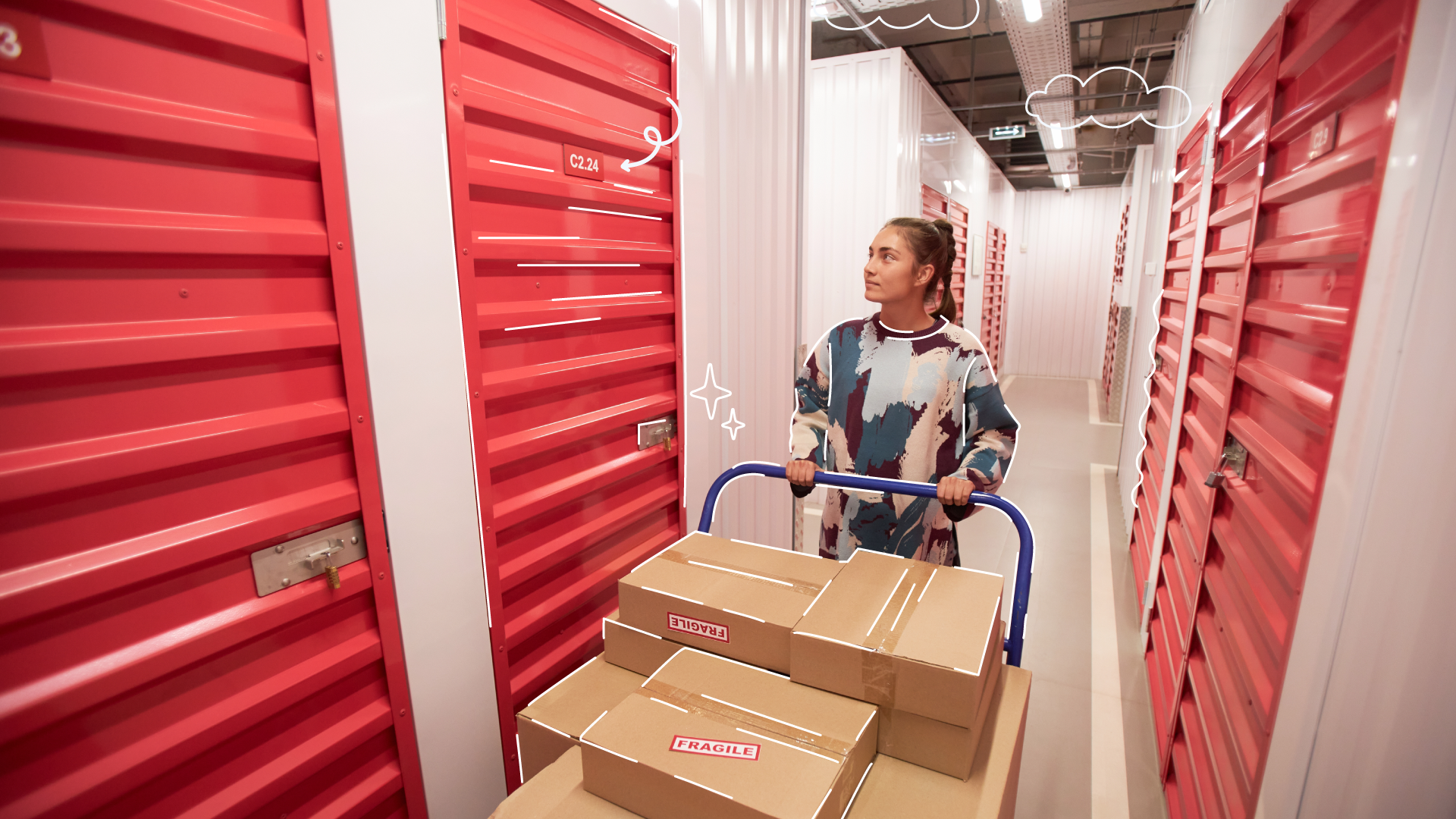
The goal of an international move may be to take your life into a new frontier. But you are not your stuff, and your mental and financial health are worth exploring some other options.
This is especially true in situations where you may come back to your country of origin at some point.
Maybe you’re moving abroad on a temporary international assignment for a two-year work contract. Or perhaps you’re not sure this move will pan out permanently, or you have cherished family heirlooms you’re simply not ready to part with yet.
Regardless, putting your goods in self-storage can prevent you from either paying the high costs of international shipping or replacing all your items only to move back home.
- Domestic storage typically runs $50 to $200 a month, depending on the unit size, the storage amenities you need, and the storage location.
- Compare that to international shipping costs of $3,000 to $17,000 one-way, depending on how much you’re bringing and where you’re headed.
- Even if you store your belongings for two to three years, you could still spend less than half of what you’d pay to ship everything overseas and then ship it all back again if you return home.
Be honest about whether there’s a chance you’ll move back to your country of origin a few years after your departure. If so, self-storage is probably a more financially sound choice than selling everything now and having to re-buy it all later on to sell it all again when you move back home.
We also suggest looking into climate-controlled storage options. Climate-controlled units sit at a temperature between 55 and 80 degrees Fahrenheit all year round. They also equip humidity-monitoring and management technology to keep relative humidity within an ideal range, preserving your more sensitive belongings.
Climate control does cost a bit more than non-climate-controlled storage. But it’s worth it to protect your quality furniture, important documents, family photographs, and electronics. Extreme temperature fluctuations and drastically high or low humidity levels can cause warping, mold growth, and moisture or pest damage to these more sensitive items.
You can even find a vehicle storage facility where you can keep your car, motorcycle, or truck safe and sound while you’re gone.
Beyond the practical benefits, there’s something psychologically comforting about having a “safety net” of stored belongings back in the old country while you’re adjusting to life abroad. Knowing that your familiar items are safely tucked away back home takes the pressure off the international move, so it doesn’t feel like the stakes are so high.
If you’re feeling rushed to make decisions about what to keep or sell, or if getting rid of your belongings is making you hesitate on your final decision, you won’t be able to move forward and focus on settling into your new home.
Ready To Tackle Your Moving Abroad Checklist? Here’s How SelfStorage.com Can Help
By now, you probably have a pretty clear idea of what to expect when moving abroad. Start working down your moving abroad checklist by calculating your international shipping costs for different methods. Then work your way down your pre-moving checklist to get all your documents in order.
Once you’re ready, use the four-category decision framework of Must-Ship, Sell, Donate, Store to make informed choices about what you’re taking with you and what you’re doing with the stuff you leave behind.
Storing, selling, and donating things you won’t need can reduce your shipping volume by 40-60%, lowering your international shipping prices by thousands of dollars.
But moving abroad is already emotional enough without forcing yourself to get rid of sentimental possessions. Parting with the personal belongings that have made you comfortable can feel overwhelming, even when it’s temporary. This is especially true when you’re already facing the uncertainty of building a new life in a new country.
That said, downsizing the load you’re shipping doesn’t have to mean going full minimalist. That’s where self-storage comes in.
Whether you’re storing family heirlooms until you’re settled, keeping your belongings safe during a temporary assignment, or simply creating a safety net while you test out your new life abroad, using self-storage as a solution can elevate your financial and mental health.
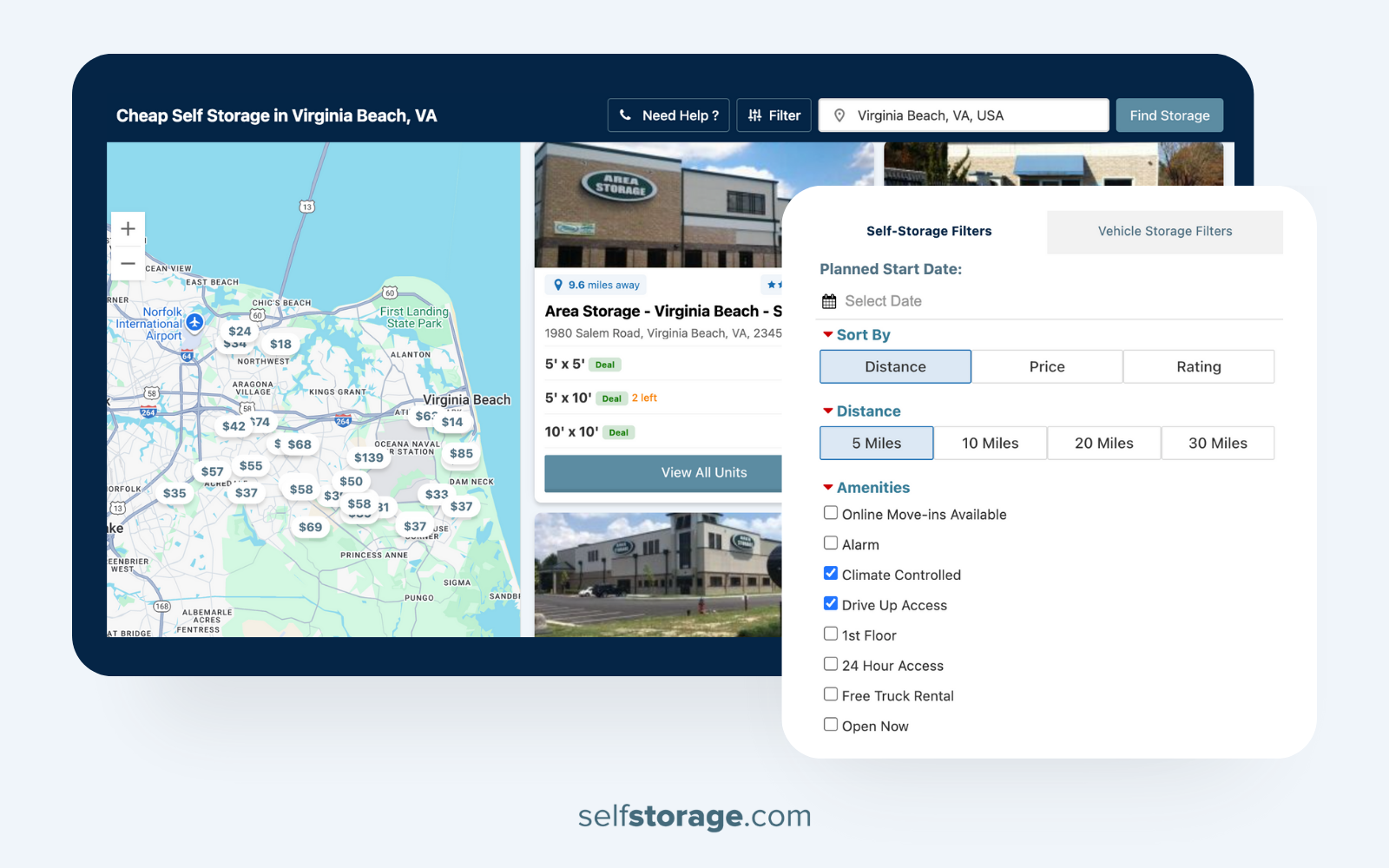
And SelfStorage.com is here to help. Our signature self-storage search tool makes it easy to compare storage facilities in your area. Just punch in your zip code and use our amenity filters to isolate your ideal storage units by price, amenities like climate control and enhanced security features, and location.
Moving abroad is an emotional decision. Deciding where to store the sentimental items you leave behind doesn’t have to be. Book a storage unit with our platform now. You choose your unit and move-in date, and we take care of the rest.