Article takeaways
- A sublet or sublease allows people looking for short-term housing to rent a space from someone who’s already renting a space but not using it.
- Subletting can be more affordable and more flexible than traditionally renting an apartment.
- Consider investing in a self-storage unit to store belongings that won’t fit in a subletted space.
The housing market is in a strange place right now as lifestyles change, housing prices rise, and budgets get tighter. Many people living on their own for the first time or downsizing their lives are looking into smaller spaces that they can live in on a short-term basis. Luckily, tenants who sublet their apartments are a perfect way to live in a flexible housing situation while scouting out more permanent solutions.
If you’re a college student, young professional, relocating worker, or just a budget-conscious renter looking to save, you’re in the right place to explore different renting options. We’ll go over the difference between leasing and subletting a space, and how to decide which option is best for your needs. We’ll also offer some tips on moving and storage for flexible housing needs; we are SelfStorage.com, after all.
What is a lease, what is a sublet, and how do they differ?
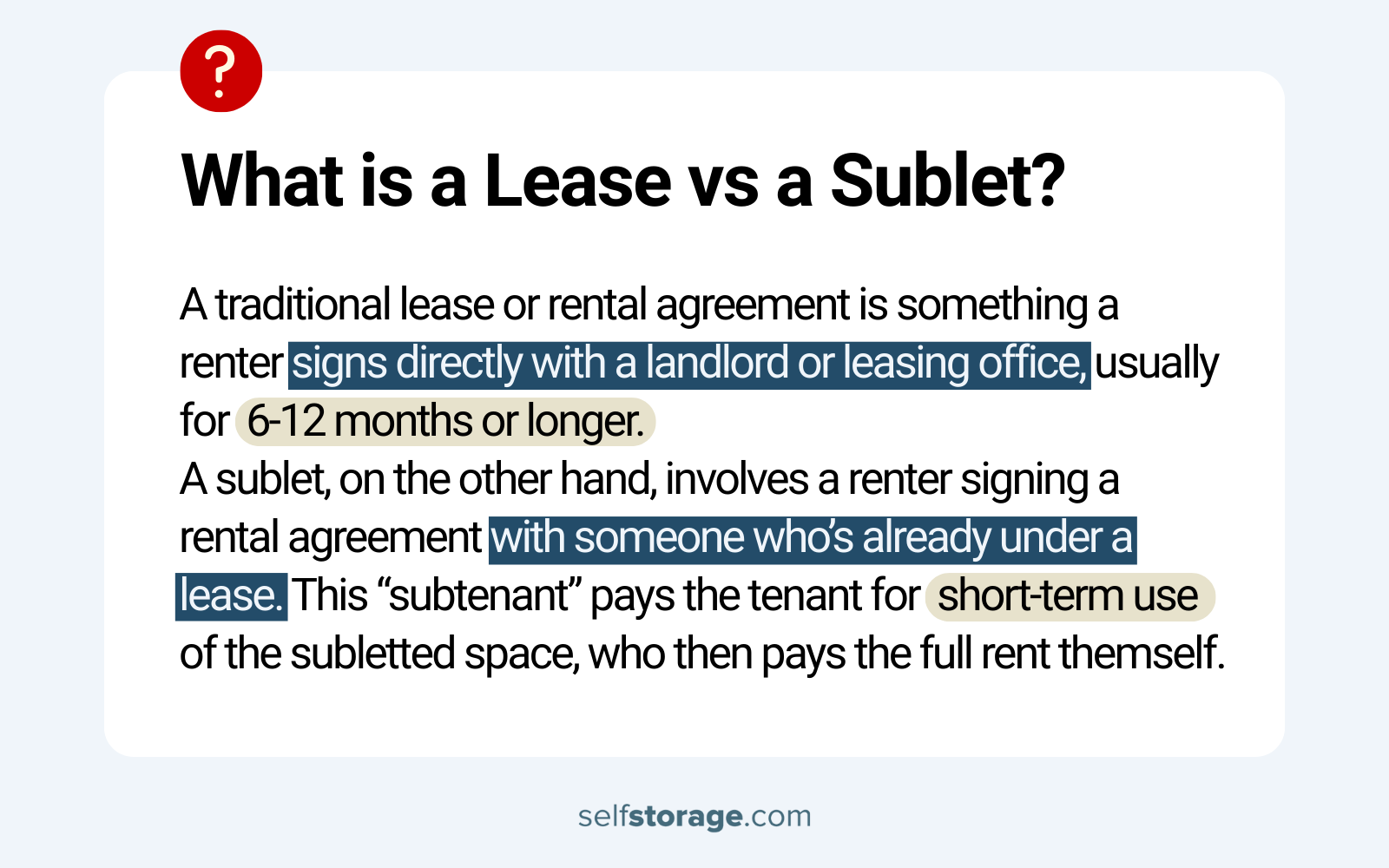
A traditional lease or rental agreement is something a renter signs directly with a landlord or leasing office. Leases are usually signed in the long term, from as little as 6 months to as long as 12 months or even longer. For example, my roommate and I initially signed our lease for 13 months. Renters will have a direct relationship with the landlord or property managers, and have direct rights and responsibilities outlined in the documents they sign when they agree to the lease.
A sublet, on the other hand, involves a renter signing a rental agreement with someone who’s already under a lease. This “subtenant” pays the tenant for short-term use of the subletted space, who then pays the full rent themself. A tenant needs to get the consent of their landlord before subletting their rental, and all three parties sign a shorter-term agreement for the subtenant to pay rent to the tenant.
Tenants sublet their spaces when they need assistance paying their rent for several reasons and won’t be using their apartment space; they could be spending an extended time away from the rental, such as an overseas contract job or a long-term vacation, or they could simply have financial troubles that require extra payment. Subtenants take these opportunities for shorter-term housing and more flexibility.
An important note: A sublease does not replace an original lease. True to its name, it supplements it, meaning the original tenant is still responsible to the landlord for paying rent and maintaining the property; the subtenant is directly responsible to the tenant for their share. However, the tenant can file a legal claim against the subtenant if they don’t hold up their end of the bargain.
Differences at a glance:
| A traditional lease: | A sublease: |
|---|---|
| Is signed in the long term (6-12 months) | Is signed in the short term (3-6 months or less) |
| Is signed directly with the landlord | Is signed between the tenant, subtenant, and landlord |
| Leaves the renter directly responsible to the landlord for payment and following the lease terms | Leaves the sublease renter directly responsible to the renter, who is still directly responsible to the landlord for payment and following the lease terms |
| Binds the renter by standard lease terms and conditions outlined by the landlord | Binds the sublease renter to a sublease drawn up by the renter, as well as the terms of the master lease |
How does the subleasing process work?
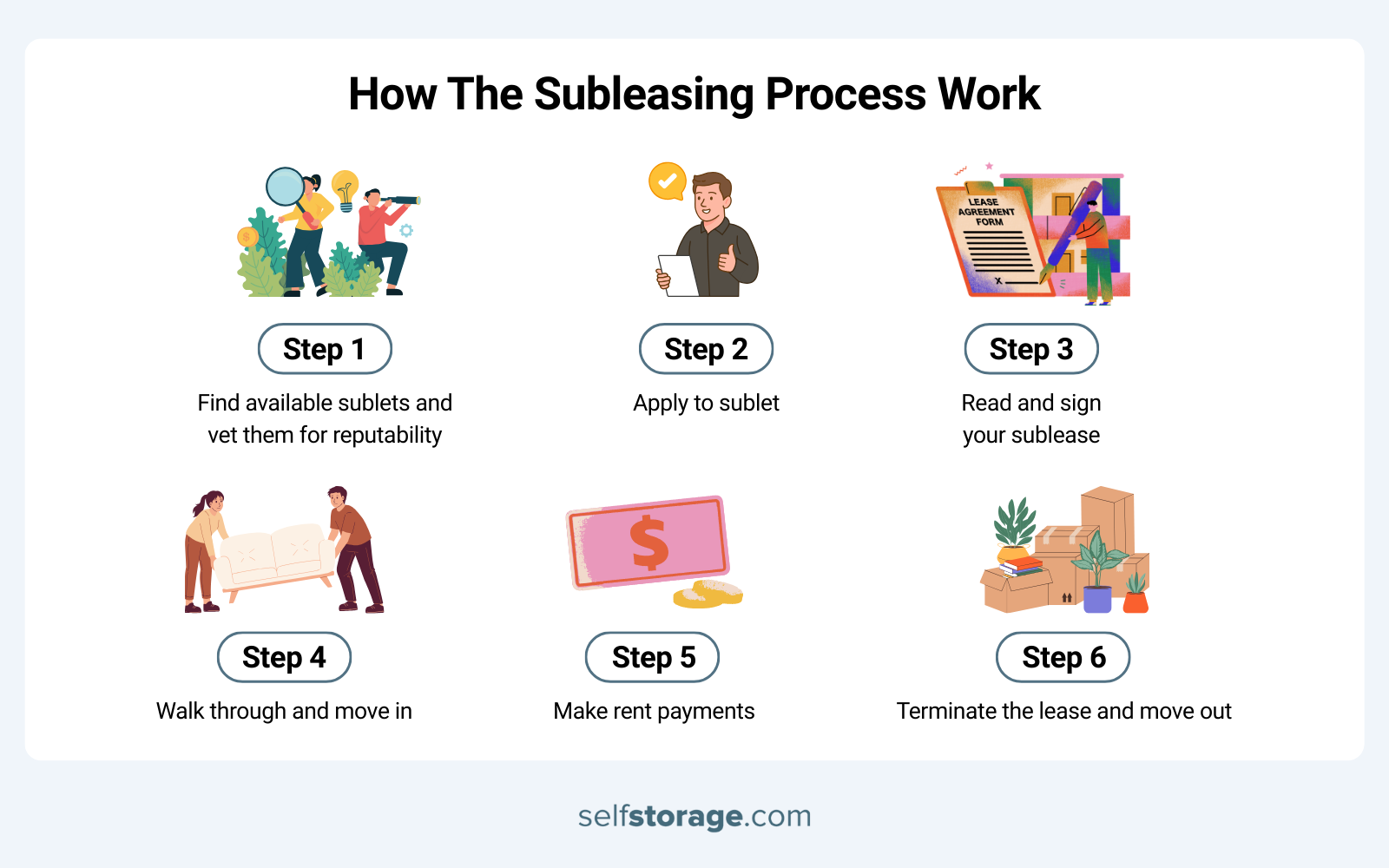
Find available sublets and vet them for reputability
If subletting seems like the perfect solution for your housing needs, the first step will be finding one. Use online platforms like Zillow, university message boards, or social media to find people looking to sublet their space. Don’t just jump in without checking to make sure they’re legitimate, however! Ask the following questions to see if any red flags pop up:
- Do you have permission from your landlord to sublet this space?
- This is a basic legal requirement of subletting. If the person you’re speaking to is evasive or clearly subletting without permission, you could end up in legal trouble alongside them.
- May I walk through your rental space?
- A reputable subletter will let you see the space you’re considering before renting, and you’ll be able to get a feel for the space before signing an agreement.
- Why are you looking to sublet?
- Truthful answers to this will help you get a feel for the subletter and how they are to work with.
- What expectations would you have from me if I were to sublet from you?
- Asking this question up front will allow you to see if the person you’re renting from is unreasonable with their terms and expectations.
Apply to sublet
Once you nail down a place to sublet, you’ll have to apply just as you would with a regular rental. Bring proof of your identity, pay stubs to prove your income, and references so the tenant and landlord know you’ll be a responsible subtenant. In some cases, you’ll have to meet the landlord in person alongside the person you’re renting from, so have your documents ready for this as well.
Read and sign your sublease
When it’s time to read and sign your sublease, read it very carefully! A well-written sublease should include:
- Direct reference to the “master lease: Subtenants are bound by the same regulations as tenants while living in the space.
- Information about a security deposit and how it will be handled: The tenant needs to comply with state escrow requirements, so they should hold on to the subtenant’s security deposit in a separate interest-bearing account.
- Clearly defined responsibilities for utilities and maintenance: The subtenant is responsible for little things like changing lightbulbs, but there should be information on how they can contact the tenant about major repairs.
- What the subtenant is legally liable for: Subtenants don’t have a direct contract with the property landlord, so they have to notify the tenant of any repairs needed and agree to compensate the tenant for any damages resulting from their actions.
- What costs the subtenant must pay up front: In addition to security deposits, tenants usually require a month’s rent from their subtenant.
Walk through and move in
As with any rental, you should walk through and take pictures of the property you’re subleasing before you move in so you have documentation in case something comes up that leaves your security deposit in jeopardy. Moving will typically be easier than when you rent or own a full property, as you’ll get to use most of the furnishings that are already there.
However, moving and storing can still be a hassle if you find you don’t have enough space for all your stuff. You can save a little space at a low price by renting a storage unit to keep that stuff in and rotate out some of your belongings as you get comfortable.
Make rent payments
During the sublease, you’ll be paying your rent directly to the property’s tenant, who will act as the middleman and pay it to the landlord. Maintenance requests will follow the same chain: you request from the tenant, who then requests from the landlord. However, in the event of an emergency or communication breakdown, you may have to directly ask the landlord for help; a good subletter won’t let this happen in the first place.
Terminate the lease and move out
When it’s time to move out, you need to give the tenant notice in advance if it’s before the agreed-upon time your lease ends. Make sure the property is in the same or better condition than you found it when you took pictures, and you should get your full security deposit back without issue.
What are the pros and cons of subleasing?
Advantages
Subletting provides a unique opportunity for those looking for shorter-term housing situations with lower commitment. Some of the advantages include:
- Flexibility. Signing a sublease will allow you to live in an already-furnished property without committing to a long-term lease. If you’re planning to stick around for a certain number of months, you can sign a sublease for that length of time; if you’re living month to month, you can make that work too. It’s also much easier to terminate a sublease and move out when you need to.
- Affordability. Subleases have lower upfront costs than full leases, such as smaller security deposits, little to no application fees, no broker fees in many cases, and furniture and furnishings often included. Many subleases also charge lower monthly rent with included utilities, and shorter-term commitment allows you to save money over time for a more permanent housing solution.
- Faster move-in. Subleases come with less paperwork than a full lease, saving time on reading and signing. Your direct contact with the tenant means you’ll be approved quicker, and you can move in on short notice if you need to. A fully furnished apartment means you won’t have to move furniture, either.
- Unique opportunities. The short-term nature of a sublease enables you to try out a new city or location to see if it’s right for you. You can live in a desirable neighborhood on a lower budget if a sublet is available, and again, many subletted apartments and spaces come with the main tenant’s furnishings for you to use.
Disadvantages
Take the following into consideration when deciding whether or not to spring for a sublease.
- Less control and legal protections. A subtenant can’t make modifications to a subleased apartment, leaving them stuck with existing amenities and granting them less power to negotiate with the landlord. They also have fewer tenant rights and their living situation is dependent on the original tenant’s lease, leaving them vulnerable to eviction if the tenant doesn’t pay rent.
- Uncertainty. Many factors are up in the air with a sublease; the tenant could return early without warning, the lease could end unexpectedly, or you may end up with maintenance issues that don’t get resolved if the tenant doesn’t communicate them to the landlord. Do a thorough background check to make sure the tenant you sublet from is reputable and allowed to sublet their space.
- The landlord is still present. Not all landlords allow subleases, so you run the risk of legal trouble if they haven’t approved a tenant’s sublease. You’re also not the priority tenant; the main tenant is responsible for paying the landlord and relaying messages from the subtenant. Pay attention to any subtenant restrictions included in your sublease.
- Limited space and customizability. Subletting a rental means you’ll be living with someone else’s style and furniture, trading off affordability for a space you can’t personalize. With less space to put your own personal belongings, it may be a good idea to invest in a storage unit to save that space.
What are the pros and cons of traditional rentals?
Advantages
If you have a higher budget and want to invest in a longer-term living situation, traditional leases still exist for your needs. Some of their advantages include:
- Full control and legal protections. While you’re bound by the terms of the lease, being the primary tenant means you can mostly do what you want with your space; decorate, furnish, and choose utilities based on your own preference. You’ll also enjoy full tenant rights under the law and clear, direct communication with the landlord without a middleman, as well as standard protections against eviction.
- Stability. Signing a long term lease means you’ll essentially pay the same rent costs every month with only slight variations for utilities. You’ll also have opportunities to renew your lease when it runs out, and score potential discounts for re-signing early.
- Opportunities to build credit. Paying rent on time each month is reported to credit bureaus and establishes you as a reliable tenant. Some properties enable faster rent reporting for higher credit score boosts, and a good landlord will act as a reputable reference if you plan on moving to a new location or buying a home.
- Long-term planning. Living somewhere in the long term gives you a stable base to build your career, whether you work from home or in an office. You’ll be able to invest in your neighborhood and be part of your local community, and if you have children, you’ll be in the same school district for a long time and won’t have to switch constantly.
Disadvantages
Renting traditionally comes with its own complications and considerations, such as:
- Higher upfront costs and longer-term commitments. You’ll have to pay a larger security deposit as a main tenant, pay application fees, and invest in the full costs of moving. You’ll also have to sign a 6-12 month lease agreement, giving you less flexibility and leaving you open to extra costs if you choose to terminate your lease early.
- Longer approval processes. Renting traditionally means you’ll need to bring more documents, such as a verification of your income. You’ll also be subject to extensive background checks, reference checks, and credit score checks, and will need a longer time to wait for approval. There’s also the chance you won’t be approved if you don’t have a minimum credit score or stable employment history.
- Limited availability. Traditional leases offer fewer short-term options than subleases, and the markets are highly competitive, meaning someone can easily rent a unit out from under you if you wait too long. Markets also fluctuate throughout the year; peak moving times are between Memorial Day and Labor Day, leading to potentially higher rent and moving costs.
- Unfurnished units. With many apartments, you’ll need to purchase or bring all your own furniture; my current apartment required my roommate and I to purchase our own bed frames, couches, tables, office desks, and bookshelves. You may even need to look into storage units if moving your furnishings becomes too complex or you don’t have the space to move everything at once.
How do I decide between subletting or signing a traditional lease?
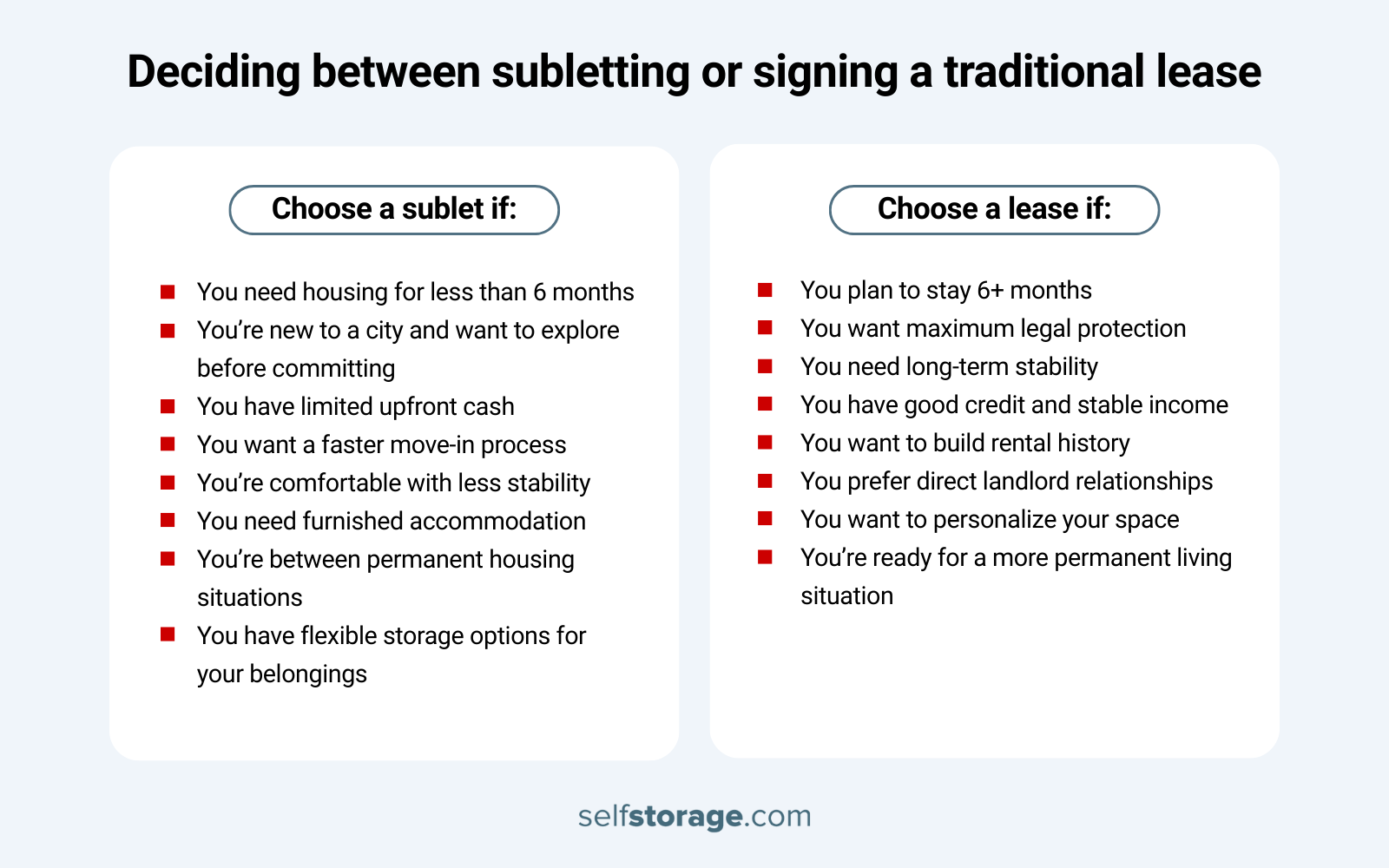
Choose a sublet if:
- You need housing for less than 6 months
- You’re new to a city and want to explore before committing
- You have limited upfront cash
- You want a faster move-in process
- You’re comfortable with less stability
- You need furnished accommodation
- You’re between permanent housing situations
- You have flexible storage options for your belongings
Choose a traditional lease if:
- You plan to stay 6+ months
- You want maximum legal protection
- You need long-term stability
- You have good credit and stable income
- You want to build rental history
- You prefer direct landlord relationships
- You want to personalize your space
- You’re ready for a more permanent living situation
Not sure whether one option is better than the other for you? Try out a hybrid approach, such as starting out with a sublet while you seek out a more permanent rental. A sublet lets you test out cities, towns, or neighborhoods to see if they’re right for you before you sign a long-term lease, and gives you more flexibility if you’re going through a transitional period in your life.
Storage units are a cost-effective way to give you extra space and flexibility while you explore your options. If you have furniture or bulky belongings that won’t fit in a subleased space, keep them in storage until you’re ready to move into a space where you’re the primary tenant.
What can I expect to pay for a sublet compared to a traditional lease?
Sublet costs
When you’re a subtenant, you’ll pay much less up front and enjoy lower costs from month to month. Utilities are often included and covered by the person you sublease from, security deposits and application fees are much lower, and the only extra costs you may end up with will be for storage unit rental if you need to store belongings that won’t fit in the sublet.
Lease costs
Renting from a traditional lease will cost you quite a bit more up front. You’ll pay 1-2 months’ rent in a security deposit, full application fees, the first and last month’s rent up front, and some utility setup deposits. Unfurnished apartments will also run up some costs for furniture, moving expenses, and storage unit costs during your move-in. This is all in addition to you bearing full responsibility for monthly rent.
Sublets vs. leases in Manhattan, NYC, USA
Here, we’ll use Manhattan as a baseline; it’s much higher than the national average, but it should help you understand how much you can save by subletting from someone in an expensive area.
| Traditional lease | Sublease | |
|---|---|---|
| Rent | Median average $4,750/month as of 2025 | Can go as low as $2,995/month |
| Upfront cost | Average $10,454 as of 2023, including a broker’s fee | Can be as low as $5,990 (one month’s rent + security deposit), avoiding a broker’s fee |
Why should I consider renting a storage unit when subletting or renting?
For subletters:
If you’re subletting an apartment, investing in a storage unit nearby will help you with everything from saving space to protecting your valuables. Furniture you own that may not fit in a furnished apartment will be kept safe and secure in a climate-controlled storage unit, and precious or valuable belongings can be protected in a storage unit if you’re worried about their security in your sublet. Using a storage unit also gives you more flexibility when you need to move quickly to a new place.
For traditional renters:
Renting traditionally can also benefit from a storage unit. Use it for temporary storage while you move in or out, space to keep seasonal items that may not have a good place in your apartment, or space to put excess furniture or bulky belongings that you may not be able to fit in a smaller apartment. Storage units are also perfect if you’re transitioning to a new lease, or if you plan on subletting your own space out and need to make room for a new subtenant.
Choosing the right storage solution
Different storage needs require different storage units. If you’re living short-term, choose a month-to-month storage option; if you’re renting long-term, rent a unit for an extended period. Choose a climate-controlled unit to store sensitive items.
Consider how much space you need, how easily you need to access a unit, and how convenient the storage facility needs to be to your old or new living space. If you’re willing to compromise on some of these factors, you can save plenty of money on an already cost-effective storage unit.
The benefits of storage for flexible housing
Storage units offer all kinds of benefits if you’re uncertain or need flexibility while you move or sublet from someone. Keeping larger items in storage offers you more freedom to accept short-term housing, keeps you from having to sell off belongings between moves, and makes the transition between a furnished and an unfurnished unit much simpler. Having a dedicated space for some of your belongings will also give you more peace of mind if you’re uncertain about your next housing steps.
What are my next steps when deciding between a sublet or lease?

Assessment checklist
When it’s time to make a decision for your next housing situation, make an assessment checklist to ensure you make the right choice. Ask yourself the following questions:
- How soon do I need to move?
- What budget do I have?
- Do I need a more flexible solution, or a more stable one?
- Do my credit and rental history prove I’m a reputable tenant?
- What storage needs do I have for my belongings?
- What are my long-term housing goals?
Next steps for subletting
If subletting is right for you, search through online postings such as those on Zillow or Sublet.com, or look through university message boards. Some sublets can even come from a trusted friend requesting one on social media. Prepare proof of your identity and income, and remember to ask questions before you make a decision so you don’t get scammed.
Next steps for traditional renting
Make sure your credit score is in a good place before you start searching for apartments and applying as a potential tenant. Search through postings on sites like Zillow and ApartmentList to find rentals that meet your budget and needs, and if you can, schedule tours to get a feel for the spaces you’ll be considering.
How do I find the right storage unit for my move?
There’s no one-size-fits-all solution to every housing need. If you need more flexibility, want to live short-term, or are on a tighter budget, subletting may be the right choice for you; if you need more stability or want to live long-term, seek out a traditional lease. Whatever you choose, be sure to look into storage units to help you move, store, and save space wherever you end up.
When it’s time to look for a storage unit that meets your needs and budget, take a look at SelfStorage.com’s built-in search tool to compare the best units and facilities near you.