
Article takeaways
- Manhattan leads the nation as the most expensive US city to live in at 132% above the U.S. average, followed by Honolulu (82.1%) and San Jose (81.1%), with housing costs being the primary driver across all expensive markets.
- Hawaii tops the most expensive state rankings with a cost-of-living index of 193.3, where housing costs three times the national average, and only 29% of residents can afford to buy a home.
- California dominates the most expensive cities list with five of the top ten slots (San Jose, Orange County, San Francisco, Los Angeles, and San Diego), driven by tech industry growth, housing shortages, geographic constraints, and a massive supply-demand imbalance across the state.
There are lots of reasons to leave home and try out a new city.
The enchantment of a vibrant life in a bustling new place, fresh new career opportunities, and alluring climates can draw people in.
But between remote work making lots of Americans more mobile and surging economic instability, the cost of living is on the rise everywhere. That said, some places have a bigger and bolder price tag than the rest.
And if you or someone you know is feeling adventurous about moving to a new place, learning about the most expensive places to live in the US is a good place to start your research.
This helpful guide covers the most expensive cities and the states with the highest cost of living in 2026.
We’ll cover what to consider when moving and the hidden costs some adventurous movers may not expect. We’ll also offer some tips on how to manage the high costs of living in expensive places.
And last but not least, we’ll reveal how our signature SelfStorage.com search tool can help you shave some money off of your moving costs.
Most Expensive States: Which States Have the Highest Cost of Living?
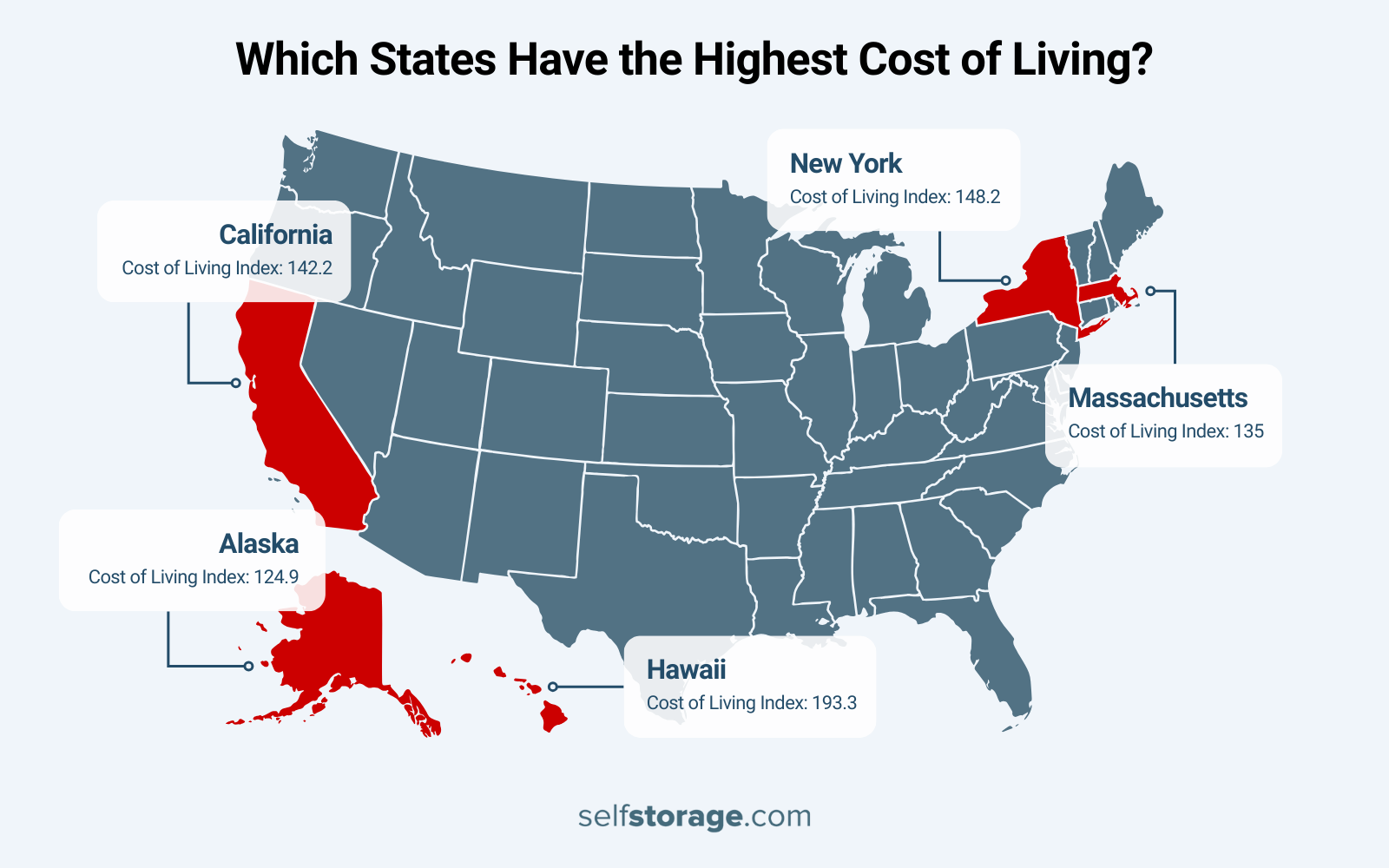
There are lots of factors that come into play when it comes to boosting or lowering the cost of living, and city life is certainly one of them. But factors like home prices and the cost of groceries, medical care, transportation, utilities, and other essential goods and services can sometimes boost the cost of living in the whole state. Before we get into the most expensive cities in the United States, let’s take a look at the states with the highest cost of living.
1. Hawaii
- Cost of Living Index: 193.3
- Housing: 315
- Utilities: 164.
- Groceries: 152.9
- Transportation: 133.7
- Health: 115.3
It’s no secret that the paradise of Hawaii is a popular destination. But supply and demand aren’t the only reasons why Hawaii tops the list of the most expensive places to live in the US.
For starters, the median home price in Hawaii flies above our heads at $$816,383, making Hawaii the state with the highest home costs. In fact, housing costs three times the national average (315 on the index), and only 29% of residents can afford to buy a home in the state, one of the lowest levels in the country.
The indigenous community of Hawaii has long since figured out how to live in harmony with the natural ecosystem of the island. But the modern American is accustomed to a lifestyle full of amenities, comforts, goods, and services that have to be shipped to the islands.
And that means groceries cost 50% more than the national average (152.9 on the index), while transportation (133.7), utilities (164.2), and miscellaneous expenses (126.7) are all significantly higher than on the mainland.
That said, property taxes in Hawaii are relatively low, and median household income is higher than the national average—but not double. So in the end, the towering costs of living stretch your income regardless.
2. New York
- Cost of Living Index: 148.2
- Housing: 230.1
- Utilities: 99.8
- Groceries: 118.4
- Transportation: 108.7
- Health: 102.5
The Big Apple didn’t earn its bold reputation as a global hub of finance, culture, and commerce without securing an even bloder a price tag. And that price tag makes New York one of the most expensive places to live in the US.
The sheer population density in the New York metropolitan area drives housing costs to hard-to-afford levels, with housing costs about 1.5 times the national average. In New York City itself, a two-bedroom apartment will set you back around $5,874 a month on average. Statewide, the typical single-family home costs $$498,383. Even at that price, only a quarter of residents can afford to buy. New York may have the seventh-lowest housing affordability rate in the country on paper, but it also boasts the lowest rate of homeownership in the entire nation.
New York’s individual income tax rates sit on the higher side, so even families with high incomes on paper find themselves stretched thin. The median income for a family of four is $111,054 per year. But the living wage for a family of four is $110,255–and plenty of families fall short. Property taxes average $6,325 a year, adding yet another burden to an already high cost of living.
3. California
- Cost of Living Index: 142.2
- Housing: 201.9
- Utilities: 124.3
- Groceries: 113.7
- Transportation: 131.7
- Health: 110.7
The Pacific coast tends to top the list of desirable places to live, so it’s no surprise that the Golden State of California is the second most expensive state to call home.
The dream of owning a home on the sunny coast of California isn’t unique. California’s real estate market is hard to break into. California’s median home value floats around $755,330.
And the annual housing costs aren’t the only driving force behind Cali’s high cost of living. The higher-than-average cost of groceries and transportation will help you spend your family’s median household income, even if the average income is on the higher end of the national spectrum.
The housing costs and the general cost of living, coupled with the dense competition and high entry barriers, make California an expensive state.
4. Massachusetts
- Cost of Living Index: 135
- Housing: 177.6
- Utilities: 111.1
- Groceries: 119.3
- Transportation: 111.3
- Health: 118.8
High grocery, medical, and housing costs put Massachusetts in the number 3 slot of the most expensive states. Mass has a median home value of $636,412, and that’s before you consider property taxes that are almost double the national average.
Medical care expenses are almost 15% higher than the national average, with health insurance sitting at 18% more expensive. Groceries cost 19% higher in Massachusetts.
The median household income is robust in Massachusetts, with the average family of four earning $140,309. And the medical care and school systems are some of the best in the country. But quality of life comes at a price.
5. Alaska
- Cost of Living Index: 124.9
- Housing: 120.0
- Utilities: 157.0
- Groceries: 127.0
- Transportation: 117.0
- Health: 145.0
Rugged beauty and expansive wilderness make Alaska a one-of-a-kind place to visit. And Alaskan residents enjoy the financial advantage of no state income tax. But the advantage, unfortunately, doesn’t outweigh the cost-boosting logistical challenges Alaskans face.
The massive size of Alaska’s territory and its dispersed population make shipping consumer goods an expensive task. And since much of Alaska’s terrain isn’t farmland, Alaskans rely on food that’s shipped in from other places. That makes groceries cost nearly a third more than the national average.
The transportation, connectivity, and transfer challenges make utility costs higher than average, and medical care expenses run Alaskans over 50% more than what the rest of the country pays.
Alaska is an interesting case–the median household income in Alaska is higher than the national average. And the median home value in Alaska is $377,398, which is lower than most places on our list. But the overblown cost of everyday necessities makes Alaska an expensive place to call home.
Now we understand the most expensive cities to live in. That said, when we’re figuring out the states with the highest costs of living, we’re looking at averages across the entire state.
Many of the averages are skyrocketed by the cost of living in the sites within the state. So if you’re planning to move long-distance across state lines, you’ll need to look up the cost of living in the actual city or town you’re considering, as it may vary greatly from the state average. On that note, let’s focus on the most expensive U.S. cities.
The Most Expensive US Cities Explained
Maybe you’re looking for a lavish new life among other aristocrats. Or maybe you’re aiming to steer clear of pricy places to live. Either way, one of the primary things to consider when vetting a new place to live from any of the popular Best Places rankings is the cost of living.
But how do they determine which US cities are the most expensive in the first place?
Organizations like the U.S. Census Bureau, U.S. Department of Labor, and U.S. Bureau of Economic Analysis, and others collect and provide info on
- Median Monthly Rent
- Median Gross Rent
- Median Home Prices and Home Values
- Median Household Income and Median Income
- Unemployment Rate, Average Commute
- Cost of Living Index
- Desirability Index
- Job Market Index
- Value Index
- Quality of Life Index
By cross-referencing some of these metrics, publications can get a solid idea of where the most expensive places to live in the US are for a given year. Our 10 most expensive US cities are ranked based on how much more expensive each city is compared to the national average, taking into account housing, groceries, transportation, utilities, healthcare, and other everyday expenses.
The data comes from C2ER’s Cost of Living Index, which measures prices across 265 urban areas nationwide. A city that’s 50% above the U.S. average means residents pay $1.50 for every $1.00 the typical American spends.
Here are the cities where your dollar stretches the least:
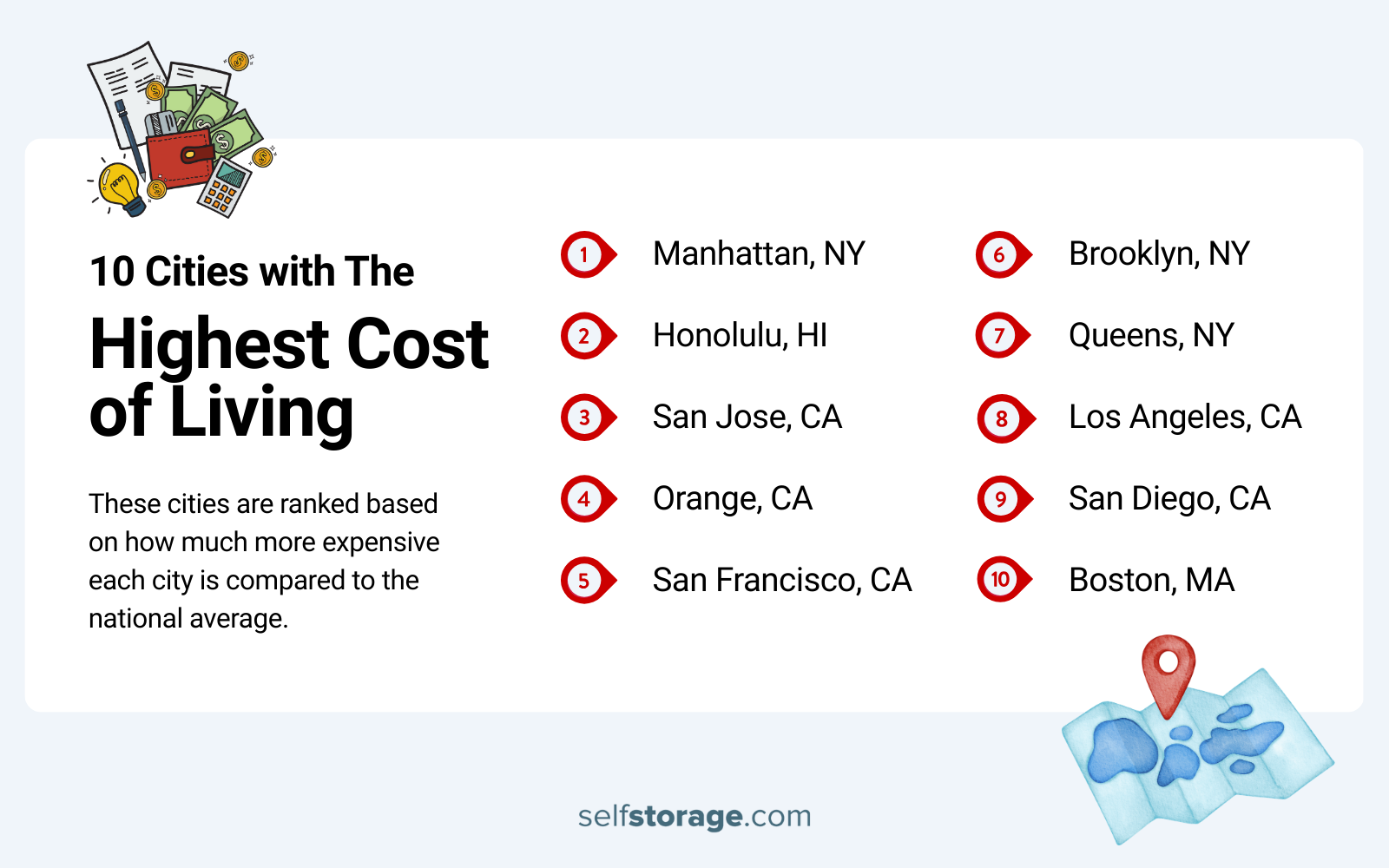
1. Manhattan, New York – 132% above U.S. average
Life in the Big Apple’s most famous borough costs 132% what most Americans pay just to get by. The average apartment rents for $5,735 a month—the highest in the nation—while the average home price hits $2.95 million. It’s no wonder that space is in high demand, since Manhattan hosts nearly 70,521 residents per square mile.
Healthcare costs run 50% above average, a movie ticket costs $22.47 (73% more than average), and transportation is 20.9% more expensive. The median household income of $101,078 isn’t too shabby. But in a city where everything costs 132% more, even six figures can feel tight.
2. Honolulu, Hawaii – 82.1% above U.S. average
As I mentioned earlier, almost everything in Hawaii has to arrive by boat or plane. Utilities are the most expensive in the US–94.4% above the mainland average. Grocery costs are high–eggs are 37% pricier, and bananas cost 102% more.
The median household income of $84,907 barely keeps up with the $1.71 million median home sale prices.
3. San Jose, California – 81.1% above U.S. average
At the heart of Silicon Valley, housing costs run 232% above the national average, with homes hitting $1,393,400. Utilities run 43.1% higher, and even your daily cup of coffee costs 18% more than the rest of us pay.
The median household income of $153,202 is nearly twice the national average, probably thanks to Silicon Valley. And you’ll need that big tech money if you’re gonna pay that extra 81% everywhere you go.
4. Orange County, California – 61.7% above U.S. average
Orange County housing costs run 173.3% above the national average, with homes averaging nearly $1.645 million. In Newport Beach alone, median values soar past $2 million. Renters pay $3,056 monthly for an average-sized rental. That’s almost double the national average.
The median household income of $110,042 provides sme cushion, and healthcare actually runs 4.1% below the national average. But paying 39.1% higher transportation costs, 39.1% and 25.2% more for utilities, keeps Orange County, California, on the list of the most expensive US cities.
5. San Francisco, California – 60.1% above U.S. average
San Francisco‘s tech-driven growth has also driven up the city’s cost of living, where demand has already outpaced supply. The average home costs $1.35 million, while renters pay $3,739 a month.
Groceries, utilities, healthcare, and transportation all cost 13.7% to 50% more than average. The median household income of $138,562 is among the nation’s highest. But when everything costs double, even tech salaries get stretched thin.
6. Brooklyn, New York – 59.4% above U.S. average
I remember when Brooklyn was New York’s cool but affordable alternative to Manhattan. These days, Brooklyn’s housing costs are almost four times the national average. The median home value hits $880,300, while on the other side of the affordability gap, the median household income of $76,912 falls below the national average.
Utilities cost 19.1% more than average, and transportation just 13.4% above the typical rates. But medical care costs run 28.8% higher.
7. Queens, New York – 50.6% above U.S. average
Queens is considered the world’s most ethnically diverse urban area, with 138 languages spoken within its boundaries.
But housing prices 152.2% above the national average. Homes sell for nearly $1.36 million, and rent costs $3,937 a month. That means homeowners and renters are paying more than twice what most Americans pay, even though the median household income is only $325 above the national average at $81,929.
8. Los Angeles, California – 49.4% above U.S. average
Los Angeles may be the home of Hollywood, but the median household income is only $79,701–less than the national average, to be sure. But the demand is still despite the lower-than-average income. So housing costs run 131.5% above average, with homes at nearly $1.35 million and rent averaging $3,011.
L.A.’s notorious traffic pushes transportation costs 28% above average. And the unemployment rate of 6.4% rests well above the national rate of 4.8%.
9. San Diego, California – 46.1% above U.S. average
The ideal weather and hot sand beaches come at a price. San Diego housing prices average $1.16 million—114% above the national average.
San Diego residents do enjoy a median household income of $105,780. But housing costs more than erase that advantage. Even renters pay $3,132 a month–just about double the national average.
10. Boston, Massachusetts – 44.8% above U.S. average
Housing costs run 114.3% above average in Boston, with apartments renting for $4,157 a month. And Bostonians looking to buy a home can expect to pay around $1,060,406 on average.
Utilities run 44.8% above average, and healthcare costs 34.4% more. The median household income of $96,931 helps, but Massachusetts ranks among the least tax-friendly states for both working families and retirees.
The Hidden Costs of Luxury Living
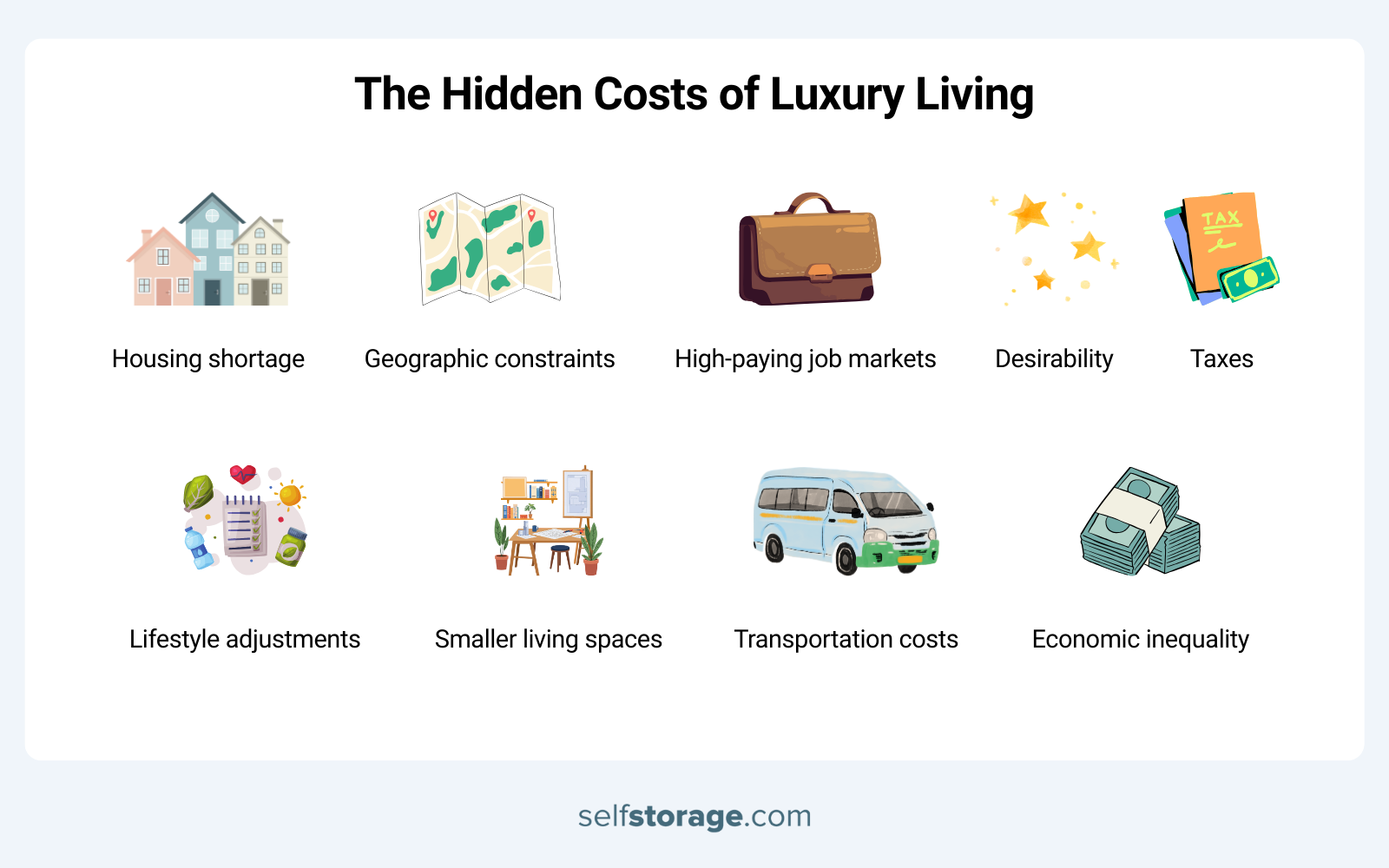
The hidden costs of moving to a luxurious place include more than the obvious costs of living. Housing is hard to come by, and the high-paying job markets are competitive. You’ll have to adjust to smaller living spaces and lifestyle adjustments, all while dealing with the sunshine tax and tourists attracted to the desirability of your area.
- Housing Shortage: In luxury markets, there is often a housing shortage, which lowers the chance of affordable housing by driving up demand.
- Geographic Constraints: Areas with geographic limitations, such as coastal cities or regions surrounded by mountains, have restricted space available for housing development. Landscape limitations often lead to elevated property values and a lack of options.
- High-Paying Job Markets: Luxury living areas often boast high-paying job markets, which boost the median income. This can definitely be a pro, but it also attracts top-tier professionals seeking to capitalize on career opportunities. That makes the job market competitive, leaving many of the residents stuck with long commutes to out-of-town jobs that don’t pay as well.
- Desirability: Locations viewed as prestigious or offering a high quality of life tend to have higher median home sale prices. Features like high-scale schools, geographical and cultural attractions, and recreational amenities attract potential residents, visitors, and tourists alike.
- Taxes: High property taxes in luxurious areas and temperate climates, often called the “sunshine tax,” increase the cost of buying a home, lowering the rate of homeownership. And more renters mean a higher rent price.
- Lifestyle Adjustments: Life in luxury housing markets often means reducing your spending in other areas. That can mean spending less on non-essential items, downsizing your home, or moving in with family members.
- Smaller Living Spaces: Due to the elevated cost of housing, residents in expensive areas often have to settle for smaller apartments or condos. This can lead to reduced living space and a lack of storage. You can navigate this by leading a more minimalist lifestyle or using self-storage to ease your transition.
- Transportation Costs: Public transportation options are often limited in places where people have money and prefer their private vehicles. This can lead to increased transportation expenses, like fuel, insurance, and maintenance costs.
- Economic Inequality: The high costs of living in luxury areas can accelerate the gap in economic inequality. Wealth inequality can create a divide between different socioeconomic groups within the same community, which can cause some drama and discomfort, to say the least.
Managing High Costs Of Living in the Most Expensive Places To Live
Maybe you already live in one of the most expensive places in the US. Or maybe you’re moving there soon. Either way, there are some budget-friendly storage tips you can try to manage the high costs of living.
The obvious solution is moving into a smaller house. But you don’t want to give away your sentimental and valuable belongings.Self-storage can support downsizing by helping you store the possessions you may not use on a regular basis.
You can take advantage of multifunctional furniture like sofa beds, expandable dining tables, or wall-mounted desks that save space, putting the rest of your furniture in storage.
You can store seasonal items such as winter coats, snow gear, or summer sports equipment in storage units to free up space in your home.
Storage also gives you a place to keep seasonal gear such as skis, rock climbing, mountain biking, and hunting gear. For example, you can keep your camping and hiking gear at home and your snowboard in storage for the summer.
When winter rolls around, swap your camping gear for your snowboard gear, and you only need to store one pile of gear at home at a time without giving up any of your hobbies.
You can use budgeting apps to keep a detailed record of your expenses and identify areas where you can cut back. Minimalism fosters more than an open, inviting living environment; simple living also frees up mental space in a noticeable way.
How SelfStorage.com Can Help Lower the Highest Cost of Living
By now, you should have a pretty good idea of the most expensive places to live in the US, both in terms of the most expensive US cities and the most expensive states. We’ve seen that, while these areas are costly, people choose them for career opportunities, lifestyle, geography, climate, or other compelling reasons.
We’ve also explained a few of the hidden costs of luxury living and how to mitigate the high costs of living when you’re living in an expensive place.
Regardless of where you move to, renting self-storage can help you ease the transition, moving into a small and affordable living space while you try out the new city. You can put your things in temporary storage while you travel freely for a bit, or while you’re between houses.
Or you can downsize your living space by putting things you don’t use every day in self storage while you decide what to keep and what to sell.
Of course, depending on what you’re storing, you may need amenities like climate control or enhanced security features. You’ll also want to make sure you’re renting the appropriate storage unit size so you’re not wasting money or cramming things into tight spaces.
And last but not least, we suggest renting a self-storage unit in a convenient location. But how do you find a self storage facijltity in your location of choice that has the exact size and amenities you need?
Don’t fret–SelfStorage.com is here to help.
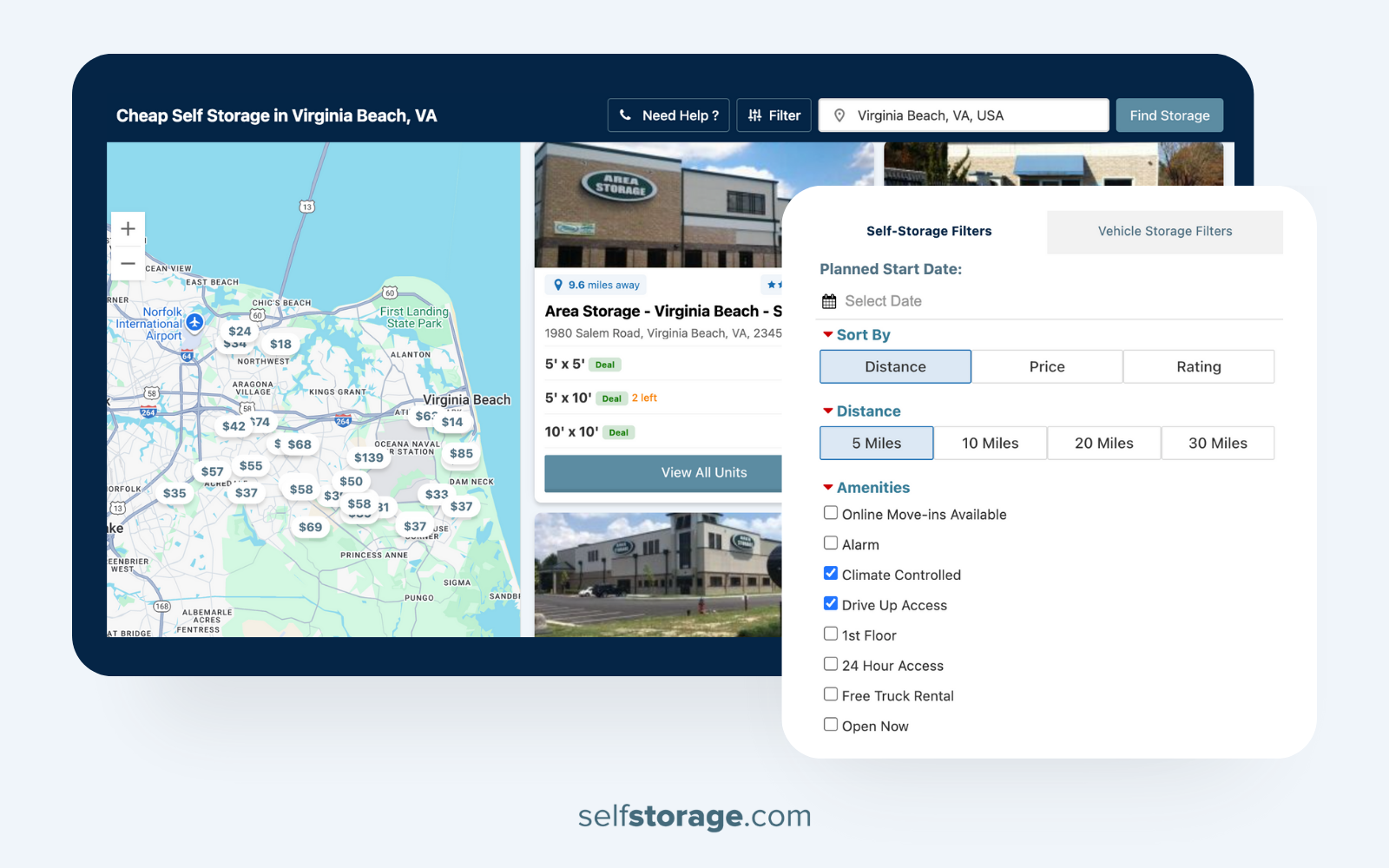
Simply use our storage unit guide to figure out the sizes and amenities you need.
Then, enter your zip code into our signature SelfStorage.com unit locator tool to find the storage unit size and amenities you decided you need in the previous step.
Our tool uses amenity filters you set to isolate the storage units in your zip code that have precisely what you need. You can contact the storage facility through our site and book your storage unit today. When you find the ideal storage unit near you, we’ll reserve it for you for free in minutes. No commitment and no credit card required.