Article takeaways
- The best bathroom organization ideas start with decluttering before adding a single bin or shelf.
- Countertops work best when only daily-use items live on the surface. Everything else belongs inside a cabinet, drawer, or closet.
- Bathroom closet organization ideas like shelf risers, labeled baskets, and clear bins make the biggest difference in shared and family bathrooms.
- Small bathrooms benefit most from vertical solutions: over-door organizers, floating shelves, and tension caddies.
- When bathroom renovations, bulk purchases, or staging create overflow, a self-storage unit is a practical short-term fix.
You’re running five minutes late, and you can’t find your concealer. You know it’s on the counter somewhere under the dry shampoo, the three face washes you’re rotating through, and the stack of things you set down last Tuesday. By the time you find it, you’re annoyed before you’ve even left the bathroom.
The bathroom is usually the smallest room in the house and somehow ends up holding more stuff than any other. Skincare, medications, cleaning supplies, towels, hair tools, and toiletries for guests. It all piles into a room that probably has six square feet of counter space and a cabinet that was never designed to hold all of it.
Good bathroom organization ideas don’t require a renovation or a big budget. They require a clear sequence and products matched to what you actually own. This guide covers every zone of the bathroom, from the counter to the closet to the shower, with practical bathroom organizing ideas for tight spaces, shared bathrooms, and everything in between.
Why Bathroom Organization Matters
An organized bathroom doesn’t just look better. It makes your mornings and evenings noticeably easier, which adds up fast when you’re in that room twice a day every day.
When everything has a place, getting ready takes less time and less mental effort. Cleaning gets easier, too. Wiping down a clear counter takes thirty seconds, and wiping down one covered in bottles takes considerably longer, if it happens at all.
There’s also the simple fact that starting your day in a calm, functional space feels different than starting it in a cluttered one. If your bathroom is contributing to a broader sense that your home is harder to manage than it should be, understanding why your home feels smaller than it is often starts in rooms exactly like this one.
Bathroom Counter Organization Ideas
The counter is where bathroom clutter starts, and it’s usually the first thing you see in the morning. Most counters aren’t actually cluttered. They just have no system for what belongs there and what doesn’t.
It comes down to one rule: only items you use every single day belong on the surface. Everything else goes inside a cabinet, into a drawer, or out of the bathroom entirely. A tray or small catch-all makes what stays look intentional rather than abandoned, and it takes about two minutes to set up.
From there, a few containment tools do the rest of the work:
- Tiered risers ($15–$35) add vertical display space without expanding the footprint
- Apothecary jars or small canisters corral cotton rounds, cotton swabs, and hair ties
- A compact drawer unit on the counter handles items that don’t fit neatly in the cabinet below
- Dispenser bottles replace a lineup of mismatched containers and cut both clutter and visual noise
The most common mistake is trying to organize a counter that has too much on it. Declutter first. Then contain what stays.
Under-Sink Storage Solutions
The cabinet under the sink is often the most wasted space in the bathroom: awkward to reach, interrupted by pipes, and easy to turn into a catch-all. Most people shove things in and close the door. It works until it doesn’t, and then opening that cabinet becomes its own small project.
Getting it functional takes about three targeted products and a tape measure. Before buying anything, measure the usable space on each side of the pipe. Getting the height right means bins that fit cleanly instead of ones forced in at an angle, and that one step prevents the most common under-sink shopping mistake.
- Pull-out drawers or slide-out organizers ($20–$45): reach items at the back without removing everything in front
- Tension rod across the middle of the cabinet: holds spray bottles by their triggers and frees up floor space below
- Stackable bins ($10–$25 each): work around pipes when arranged in an L-shape on either side
- Door-mounted organizers ($12–$30): add a full row of storage to the inside cabinet door for smaller items
- Clear bins with labels: make contents visible without pulling everything out
Bathroom Closet Organization Ideas
A dedicated linen or bathroom closet is one of the most valuable spaces in a home, and one of the easiest to let drift into chaos. Without a system, it tends to become a towel pile with some extras stuffed in around it.
The goal is to get every shelf to do one specific job. Towels stored as complete sets by bathroom (master, guest, kids) stay together and stop getting separated into halves that are no longer useful. Labeled baskets ($8–$20 each) for each family member’s personal items prevent the shared-closet shuffle where nobody knows whose dry shampoo is whose.
A few additions make the space work harder without a renovation:
- Shelf risers ($15–$25 per pair) create two rows of storage on a single shelf
- Clear bins for first aid supplies and backup products keep inventory visible without digging
- Highest shelf reserved for seasonal or rarely used items; lowest for daily grabs
If the closet is also handling linen overflow or you’re trying to get more capacity from the same footprint, vertical closet storage strategies are worth a look before buying anything new.
Medicine Cabinet & Wall Storage
Most bathrooms have more wall space than they use. The zone directly above the toilet is the most overlooked. It feels awkward to style, so it stays empty, which means storage that could have been there for years isn’t.
A mirrored medicine cabinet ($60–$150 for a surface-mount model) does two jobs at once. It hides daily products behind a mirror that was already there, and it requires no wall cutout to install. Floating shelves above the toilet ($25–$80 depending on material) work for rolled towels, small baskets, and backup supplies, and once they’re up, they’re one of the easiest spots in the bathroom to keep tidy.
For smaller items that tend to disappear (nail scissors, tweezers, bobby pins) a magnetic strip mounted inside a cabinet door keeps them in one visible spot instead of scattered across three different drawers. Pegboard panels ($20–$40 for a basic kit) are the most flexible option overall. Hooks can be moved as storage needs shift, which makes them especially useful when you’re still figuring out what the bathroom actually needs.
Small Bathroom Organization Ideas
Small bathrooms have a volume problem and a surface problem simultaneously. There’s not enough room to store everything, and there’s not enough counter or floor space to keep what does stay accessible. The answer in both cases is vertical.
Before adding anything, the first move is the same one that applies to every closet: get non-essentials out. Products used less than weekly, backup supplies, and seasonal items don’t need to live in a bathroom that’s already short on space. Once the volume is right, the vertical tools do the rest:
- Over-door organizer ($20–$50): works on the bathroom door or inside a closet door for toiletries, cleaning supplies, or accessories
- Suction cup shower caddy ($15–$40): attaches to tile without drilling and holds up to daily use
- Tension shelving between narrow walls ($30–$70): creates a full storage column in spaces like the gap between the toilet and the wall
- Storage ottoman or bench with interior storage: adds seating and hidden storage without requiring cabinet space
If you’re renting and want to avoid anything permanent, DIY renter-friendly bathroom makeover ideas cover damage-free approaches that actually work. And if the layout itself is the constraint, understanding the difference between a renovation and a remodel can help clarify whether the fix is organizational or structural.
Shower & Tub Organization
Your shower is one of those spaces where clutter accumulates so gradually you stop noticing it. By the time the caddy is full and bottles are lined up along the edge of the tub, it’s been like that for months.
The right storage solution depends on the shower type and whether you’re renting. Tension pole caddies ($25–$60) stand floor to ceiling and work well in walk-in showers with no built-in storage.
Hanging caddies ($10–$25) attach to the showerhead and work anywhere, but have limited capacity. Suction-mounted shelves ($15–$40) are the most flexible option for renters since they leave no trace when removed. For anyone doing tile work, a built-in shower niche is the cleanest long-term solution and requires zero daily maintenance once it’s in.
Whatever system you use, a periodic product purge does more than any organizer. Pull anything expired, nearly empty, or that wandered into the shower and never left. Soap dishes, shampoo bar holders, and razor hooks ($5–$15 each) handle the small items that tend to sit in standing water and cause buildup. Keeping them elevated and draining extends product life and makes the shower easier to clean between uses.
How to Organize Your Bathroom: A Quick-Start Framework
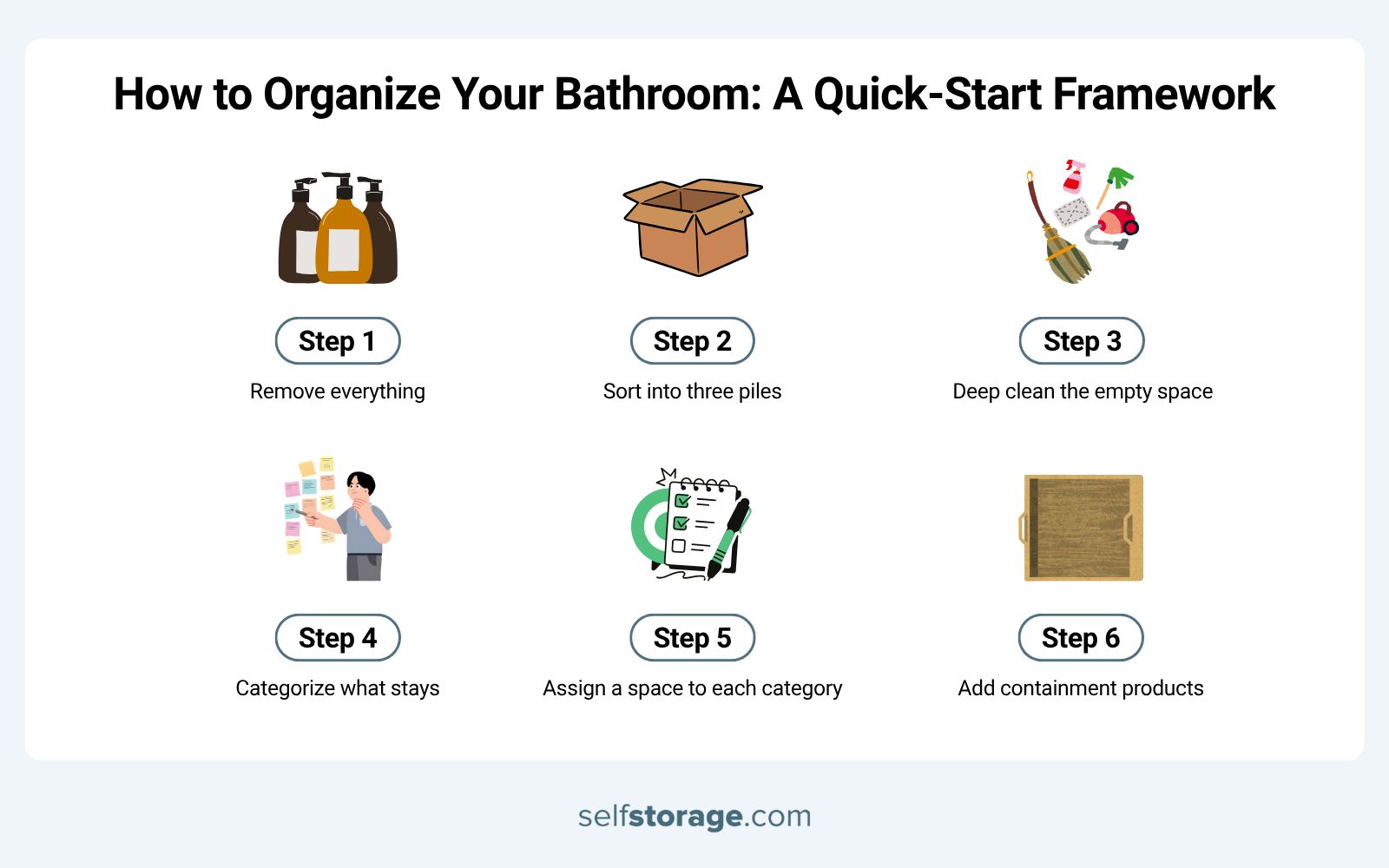
If the whole bathroom needs attention and you’re not sure where to start, this six-step framework gets it done in a single afternoon.
Step 1: Remove everything. Pull every item out of every cabinet, drawer, and shelf. Working around existing clutter is how disorganized bathrooms stay that way.
Step 2: Sort into three piles. Keep, toss, and relocate. Anything that has expired goes immediately. Anything that belongs in another room goes in a relocate pile and leaves the bathroom now.
Step 3: Deep clean the empty space. Wipe down shelves, clean cabinet interiors, and scrub the areas that are usually blocked by products. Starting with a clean surface makes the whole system feel more intentional.
Step 4: Categorize what stays. Group like items before anything goes back: daily skincare, hair tools, medications, cleaning supplies, backup toiletries, and towels. This tells you exactly what storage products you actually need.
Step 5: Assign a permanent home to each category. Daily items go at eye level and within easy reach. Backup supplies and seasonal items go higher or toward the back. Items used only occasionally get a spot that doesn’t compete with daily-use products.
Step 6: Add containment products. Now buy the bins, trays, risers, and organizers after you know your categories and measurements. Shopping before this step is how you end up with organizers that almost work.
When to Use a Storage Unit for Bathroom Overflow
Sometimes the bathroom organization problem isn’t the system. It’s the volume.
Bathroom renovations, bulk purchases, home staging, and seasonal resets all create temporary overflow that doesn’t need to live in the house.
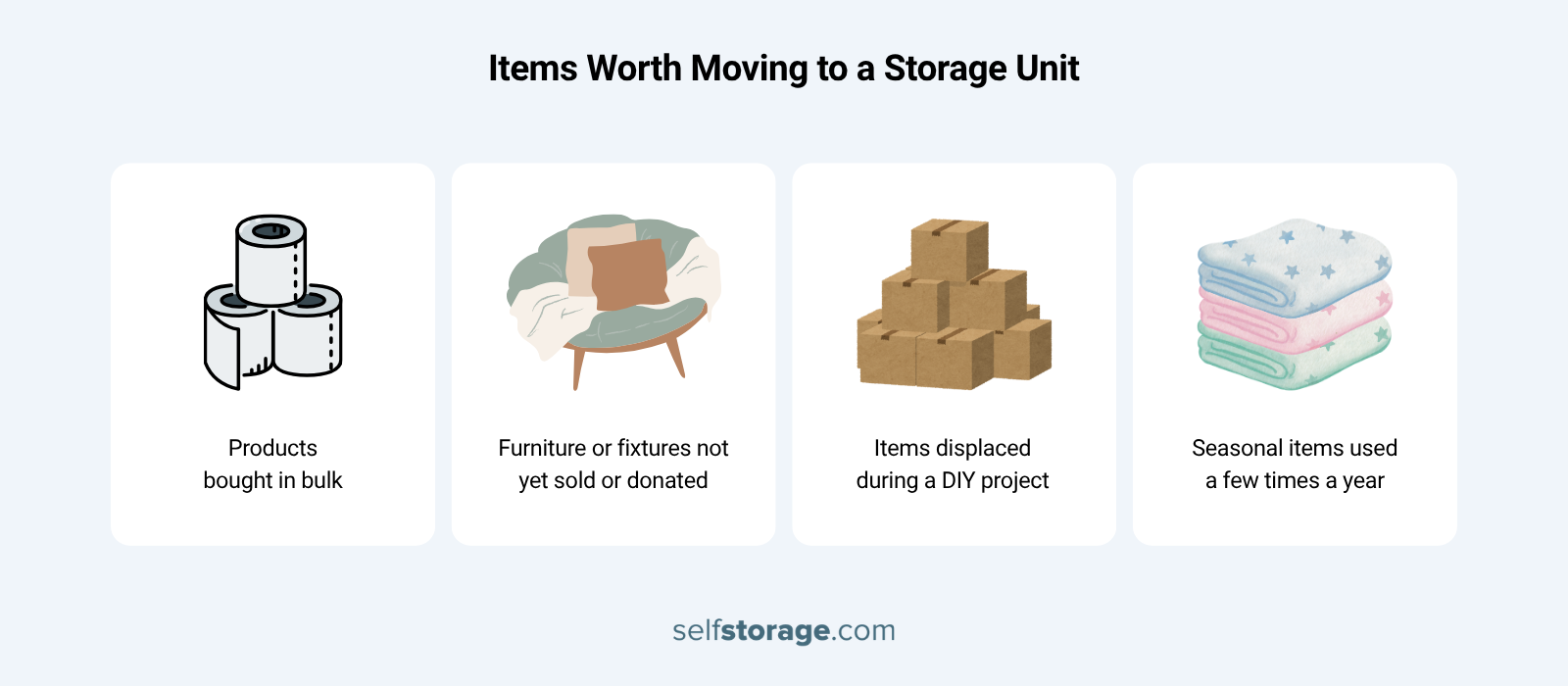
Items worth moving to a self-storage unit:
- Products bought in bulk (toilet paper, paper towels, backup toiletries)
- Items displaced during a bathroom renovation
- Furniture or fixtures are being replaced but not yet sold or donated
- Seasonal items like extra towels, robes, and guest supplies are used a few times a year
If you’re doing a bathroom renovation and need somewhere to put displaced items during construction, climate-controlled self-storage protects toiletries, cosmetics, and personal care products from temperature and humidity fluctuations that could otherwise affect them.
For anyone managing household costs alongside a home project, it’s worth knowing that storage can reduce your overall cost of living by freeing up home space rather than expanding it. And if budget is a factor, finding the cheapest storage unit prices near you is a good starting point.
Final Thoughts
A well-organized bathroom is achievable in a single afternoon. The framework is the same regardless of bathroom size: remove everything, declutter, categorize, and then add products.
The biggest shift is doing those steps in the right order. Buying organizers before you know what you own and where it’s going is how you end up with a cabinet full of bins that don’t quite fit.
If a bathroom refresh is part of a broader home reset this season, a spring refresh of the whole house is a practical place to start. The bathroom is usually one of the fastest rooms to tackle and one of the highest-impact ones once it’s done. For more organization guides, storage tips, and practical home advice, explore what’s available at SelfStorage.com.